SOC online 24/7Breach or outage? Call 858-399-4225

Free guidesinfo@alpiba.comMon–Fri, 7am–7pm PT

Alpiba

Glossary · 60 terms

IT & security terms, in plain English.

From EDR and MDR to SOC 2, RTO and zero trust: what the jargon means, and which Alpiba service covers it.

A

Agentic AI
AI systems that can plan and take multi-step actions toward a goal, such as triaging requests or updating records, rather than only generating answers.
Secure AI & Automation →
Attack surface
Everything an attacker could try to use to get in: internet-facing systems, user accounts, devices, cloud apps, vendor connections and the people behind them. Shrinking it means removing what you don't need, closing exposed services and keeping everything else patched and monitored.
Vulnerability Assessments →

B

Break-fix IT
A support model in which a technician is paid by the hour to fix problems after they happen, with no ongoing monitoring or maintenance between incidents.
Managed IT & White-Glove Support →
Business continuity
The plans and systems that keep critical work running during and after a disruption such as an outage, breach or natural disaster.
Backups & Business Continuity →
Business email compromise (BEC)
A scam in which attackers impersonate or take over a trusted email account to redirect payments or steal sensitive data.
Email Security & Awareness Training →
Business impact analysis (BIA)
A structured review of which systems and processes matter most, what an outage would cost and how long each can be unavailable before the harm becomes unacceptable. Its results set recovery priorities and the RTO and RPO targets that backup and continuity plans are built around.
Backups & Business Continuity →

C

CCPA (California Consumer Privacy Act)
California's consumer privacy law, as amended by the California Privacy Rights Act (CPRA). It gives California residents rights over their personal information and applies to for-profit businesses that meet revenue or data-sharing thresholds. It also expects reasonable security, and certain breaches caused by weak security can lead to consumer lawsuits.
Co-managed IT
A partnership in which an outside provider shares IT responsibilities with a company's internal IT staff instead of replacing them.
Co-Managed IT →
Conditional access
Sign-in rules that grant, limit or block access based on signals such as the user, device health, location and risk level.
Zero Trust & Identity Security →
Credential stuffing
An automated attack that takes usernames and passwords leaked from one website and tries them on many others, betting that people reuse passwords. Unique passwords stored in a password manager, plus multi-factor authentication, make leaked credentials far less useful to attackers.
Zero Trust & Identity Security →

D

Data loss prevention (DLP)
Policies and tools that detect and stop sensitive information, such as patient or financial data, from being shared outside approved channels.
Office 365 / Microsoft 365 →
Disaster recovery (DR)
The process and tooling for restoring systems and data after a major incident, measured against targets such as RTO and RPO.
Backups & Business Continuity →
DKIM
DomainKeys Identified Mail: a digital signature added to outgoing email so receiving servers can verify that a message came from your domain and wasn't altered.
Email Security & Awareness Training →
DMARC
An email authentication policy that tells receiving servers what to do with messages that fail SPF or DKIM checks, making your domain harder to impersonate.
Email Security & Awareness Training →

E

EDR (endpoint detection and response)
Security software on laptops and servers that watches for malicious behavior, detects threats and can isolate a device to stop an attack.
Cybersecurity & Ransomware Defense →
Endpoint
Any device that connects to your network or company data, such as a laptop, desktop, server, phone or tablet. Endpoints are where people work and where many attacks land, so each one needs updates, encryption and monitoring software such as EDR.
Cybersecurity & Ransomware Defense →

F

Firewall
A device or service that filters network traffic according to security rules, allowing approved connections and blocking the rest.
Network & Server Consulting →

H

HIPAA
The U.S. Health Insurance Portability and Accountability Act. Its Security Rule requires administrative, physical and technical safeguards for electronic protected health information.
Compliance Readiness →

I

Immutable backup
A backup copy that can't be changed or deleted for a set retention period, even by an administrator, which protects it from ransomware.
Backups & Business Continuity →
Incident response plan
A written plan that defines how an organization detects, contains, communicates about and recovers from a security incident, and who does what.
Cybersecurity & Ransomware Defense →
ISO/IEC 27001
An international standard for running an information security management system (ISMS), with a catalog of security controls.
Compliance Readiness →

L

Least privilege
The principle of giving each user, device and application only the access it needs to do its job, and nothing more.
Zero Trust & Identity Security →

M

Managed IT services
A model in which a provider proactively monitors, maintains, secures and supports a company's technology for a predictable recurring fee.
Managed IT & White-Glove Support →
Managed service provider (MSP)
A company that delivers managed IT services to other organizations, often including helpdesk, monitoring, cloud and security services.
Managed IT & White-Glove Support →
MDR (managed detection and response)
A service in which a security team monitors, investigates and responds to threats on your behalf, around the clock.
24/7 SOC & Managed Detection and Response →
MFA (multi-factor authentication)
Signing in with two or more proofs of identity, such as a password plus an app prompt or security key, so a stolen password alone isn't enough.
Zero Trust & Identity Security →
Microsoft 365 tenant
An organization's dedicated instance of Microsoft 365, containing its users, domains, settings and data.
Office 365 / Microsoft 365 →
Mobile device management (MDM)
Software that lets IT enroll, configure and secure laptops, phones and tablets remotely: enforcing encryption, screen locks and updates, installing approved apps, and wiping company data from a lost or stolen device. On personal phones it can protect work apps and data without controlling the whole device.
Managed IT & White-Glove Support →

N

Network segmentation
Dividing a network into separate zones so devices and users can only reach what they need, limiting how far an attacker can move.
Network & Server Consulting →
NIST Cybersecurity Framework (CSF)
A framework from the U.S. National Institute of Standards and Technology that organizes security outcomes into six functions: Govern, Identify, Protect, Detect, Respond and Recover.
Compliance Readiness →

P

Passkey
A replacement for passwords that uses a cryptographic key stored on your phone, computer or security key and confirmed with a fingerprint, face scan or PIN. Passkeys resist phishing because they only work on the genuine website or app they were created for, and there is no password to type into a fake page.
Zero Trust & Identity Security →
Password manager
An encrypted app that creates, stores and fills in a unique, strong password for every account, protected by one master password and MFA. Business versions add shared vaults for team accounts and central controls, so access can be removed the day someone leaves.
Zero Trust & Identity Security →
Patch management
The routine process of testing and applying software updates that fix security vulnerabilities and bugs.
Managed IT & White-Glove Support →
PCI DSS
The Payment Card Industry Data Security Standard: security requirements for organizations that store, process or transmit payment card data.
Compliance Readiness →
Penetration test
An authorized, simulated attack in which testers try to exploit weaknesses to show what a real attacker could achieve.
Vulnerability Assessments →
Phishing
Fraudulent messages designed to trick people into clicking malicious links, opening attachments, sharing passwords or sending money.
Email Security & Awareness Training →
Public Safety Power Shutoff (PSPS)
A planned power cut that California utilities, including SDG&E in the San Diego area, can call during high wildfire risk to keep power lines from starting fires. Businesses prepare with battery backup for critical equipment, cloud access to key systems and a plan for working from another location.
Backups & Business Continuity →

R

Ransomware
Malicious software that encrypts or steals an organization's data and demands payment to restore access or prevent publication.
Cybersecurity & Ransomware Defense →
RMM (remote monitoring and management)
Software that IT providers use to monitor devices, deploy patches and fix issues remotely.
Managed IT & White-Glove Support →
RPO (recovery point objective)
The maximum amount of recent data, measured in time, that an organization can afford to lose after an incident.
Backups & Business Continuity →
RTO (recovery time objective)
The maximum acceptable time to restore a system or service after an outage.
Backups & Business Continuity →

S

Security awareness training
Ongoing education that teaches employees to recognize phishing, social engineering and unsafe habits.
Email Security & Awareness Training →
Shadow IT
Apps, devices or cloud services used for work without IT's knowledge or approval.
IT Strategy & vCIO →
SIEM (security information and event management)
A platform that collects and correlates logs and security events from across an environment to detect threats and support investigations.
24/7 SOC & Managed Detection and Response →
Single sign-on (SSO)
A setup that lets people sign in once, usually with their Microsoft 365 or Google Workspace account, to reach many approved apps. SSO puts MFA and access rules in one place, so disabling one account cuts off sign-in to every connected app when someone leaves.
Zero Trust & Identity Security →
SLA (service level agreement)
A written commitment that defines the service a provider delivers and measurable targets such as response times.
Managed IT & White-Glove Support →
SOC (security operations center)
A team, supported by tooling, that monitors an organization's systems, investigates alerts and responds to threats, often 24/7.
24/7 SOC & Managed Detection and Response →
SOC 2
An attestation framework from the AICPA in which an independent auditor reports on an organization's controls for security and, optionally, availability, processing integrity, confidentiality and privacy. A Type II report covers how controls operated over a period of time.
Compliance Readiness →
Social engineering
Manipulating people, rather than hacking systems, into handing over passwords, money or access. It arrives as phishing emails, urgent calls, texts or even visitors posing as a boss, vendor or IT support. Training and simple verification habits, such as calling back on a known number, are the most practical defense.
Email Security & Awareness Training →
SPF
Sender Policy Framework: a DNS record that lists the servers allowed to send email for your domain.
Email Security & Awareness Training →

T

Tabletop exercise
A guided discussion in which leaders and IT walk through a realistic scenario, such as ransomware discovered on a Monday morning, to test the incident response plan. It exposes missing contacts, unclear decisions and slow steps before a real incident does, without touching live systems.
Cybersecurity & Ransomware Defense →
Threat hunting
Proactively searching an environment for signs of attackers that automated tools haven't flagged.
24/7 SOC & Managed Detection and Response →

U

UPS (uninterruptible power supply)
A battery unit that keeps servers, firewalls, switches and other critical equipment running through short power interruptions and gives them time to shut down cleanly during longer ones. Many also protect against surges and dips, but a UPS bridges minutes, not a day-long shutoff.
Network & Server Consulting →

V

vCIO (virtual chief information officer)
A fractional technology leader who provides IT strategy, budgeting and planning without a full-time executive hire.
IT Strategy & vCIO →
VPN (virtual private network)
An encrypted connection that lets people or offices reach a private network securely over the internet.
Network & Server Consulting →
Vulnerability assessment
A systematic review that finds, ranks and reports security weaknesses such as missing patches and misconfigurations.
Vulnerability Assessments →

X

XDR (extended detection and response)
Detection and response that correlates signals across endpoints, email, identity, cloud and network, not endpoints alone.
Cybersecurity & Ransomware Defense →

Z

Zero trust
A security model that trusts no user or device by default and verifies every access request using identity, device health and least privilege.
Zero Trust & Identity Security →
Zero-day vulnerability
A software flaw that attackers find and exploit before the vendor has released a fix, leaving defenders no time to patch. Until an update arrives, protection depends on layers such as behavior-based EDR, least privilege and network segmentation, followed by fast patching once the fix is out.
Cybersecurity & Ransomware Defense →

#

2-Step Verification (2SV)
Google's name for multi-factor authentication in Google Workspace.
Google Workspace Services →

About this glossary

How to use this glossary.

1 min readBy the Alpiba teamUpdated October 15, 2026

On this page

Technology decisions are business decisions, and they shouldn't need a translator. This IT and cybersecurity glossary explains the terms you'll meet in proposals, insurance applications, audit requests and vendor calls, in plain English and a sentence or two each.

It's written for San Diego owners, office managers and practice managers who approve IT and security choices without working in IT every day. Alongside security terms, you'll find a few that matter for local continuity planning, such as Public Safety Power Shutoffs and uninterruptible power supplies.

How to use this cybersecurity glossary

  • Search or browse. Type a term into the search box, or jump to a letter. Common acronyms such as EDR, MFA and RTO are listed the way people say them, with the full name alongside.
  • Follow the service link. Most definitions end with the service that puts the idea to work, so immutable backup leads to Backups and Business Continuity.
  • Bring it to meetings. Keep the page open during vendor calls or insurance renewals, and ask any provider to explain a term as plainly as it is explained here.
  • Check your own setup. Our security health check and cyber insurance readiness check use many of these terms. Look up anything unclear before you answer.
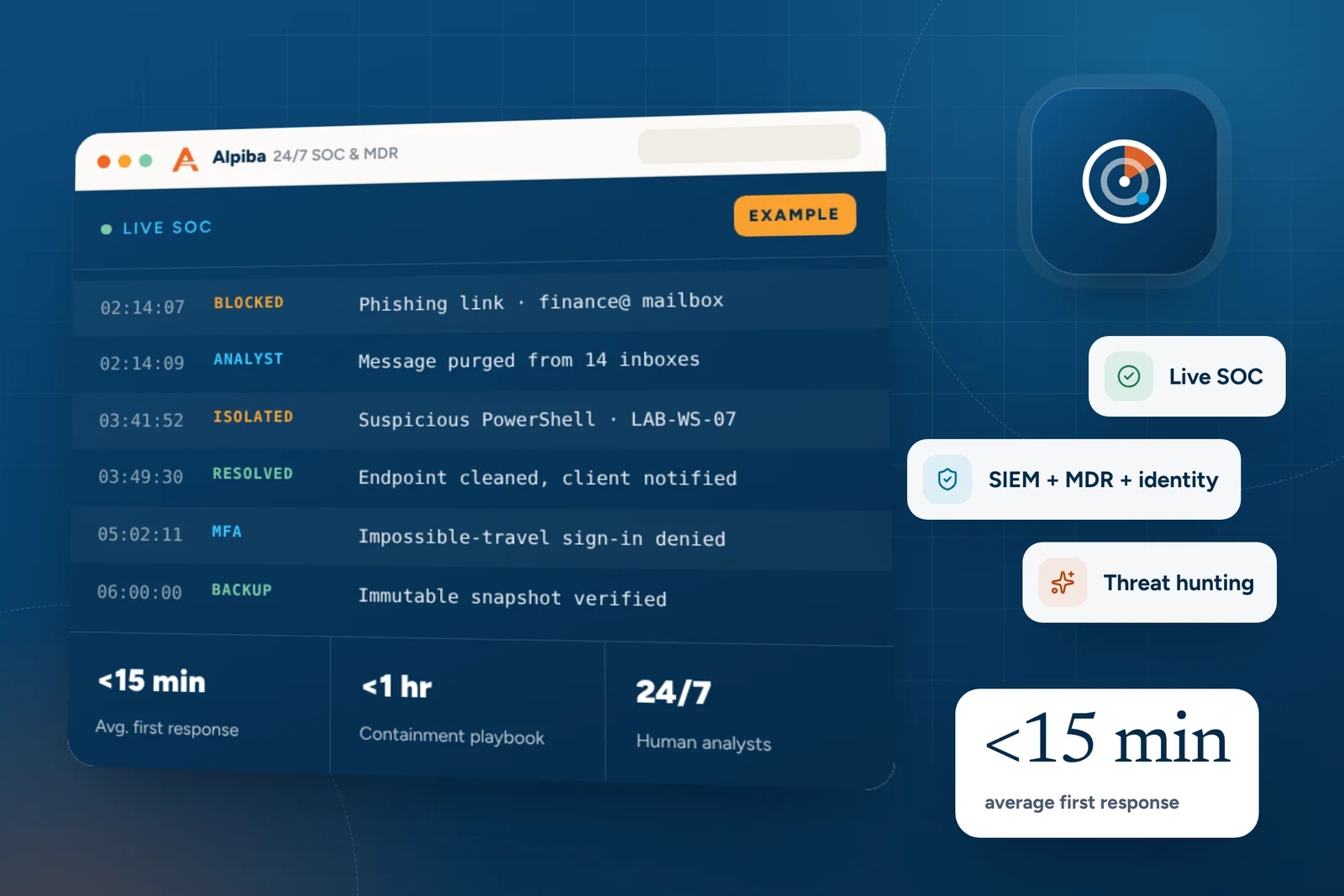
Example live soc from Alpiba 24/7 SOC & MDR, showing Phishing link on finance@ mailbox, Message purged from 14 inboxes and Suspicious PowerShell on LAB-WS-07
Example live soc for 24/7 SOC & MDR. Illustrative data, not from a real client.

Why plain English matters

Jargon hides risk. When a proposal promises EDR, MDR and a SIEM, you should be able to ask what each one does, what happens without it and how you would prove it's working. If a provider can't answer those questions in plain language, keep asking until they can.

Three questions for any term

What does it protect? What happens if we don't have it? How would we prove we have it? The answers turn a buzzword into a decision you can make.

We built this cybersecurity glossary because plain-English communication is part of how we work with every client. If a term you've heard isn't here, bring it to a free 30-minute assessment, or browse our frequently asked questions for longer answers.


Put the terms to work

Services behind the jargon.

All services
People working at laptops across a large open office

Managed IT

Managed IT & White-Glove Support

Your single point of contact for all technology, with a tailored helpdesk and on-site support backed by clear SLAs.

A close view of a glowing circuit board

Cybersecurity

Cybersecurity & Ransomware Defense

24/7 monitoring, threat hunting and rapid incident response that contains attacks before they impact your business.

A bright office with glass walls and meeting rooms

Cloud & Productivity

Office 365 / Microsoft 365

Certified onboarding, migration, security hardening and ongoing administration by Microsoft-certified professionals.

A close view of a computer circuit board

Infrastructure & Continuity

Backups & Business Continuity

Immutable backups, tested restore plans and disaster recovery playbooks so your business stays online.

A team in a working session around a conference table

Compliance & Risk

Compliance Readiness

Design, implement and evidence the controls auditors and insurers ask for, and keep the audit trail ready.

Industries we serve

Built for the industries we know best.

All industries
A scientist using a microscope at a laboratory bench

Biotech

Protect research IP, lab instruments and audit-ready data.

IP protection · Lab uptime

Law books on dark library shelves

Legal

Confidential files and secure access from anywhere.

Confidentiality · Remote access

An empty dental treatment room with a chair, monitor and cabinets

Dental

HIPAA-aligned safeguards for patient records.

HIPAA · Patient data

From our founder

“SMBs deserve a strategic technology partner, without enterprise complexity or cost.”

Roopa · Founder, Alpiba · former Accenture advisor

Plain English is a promise we keep in every report, review and conversation.

Roopa, founder of Alpiba, standing outdoors in a white polka-dot dress

Free 30-minute assessment

Still sounds like jargon? Ask a human.

Callers reach a senior engineer, not a call queue. We explain things in plain English, starting with a free 30-minute assessment.

  • A senior engineer, not a salesperson
  • Reply within 12–24 hours
  • Flat per-user pricing if you want our help
Roopa, founder of Alpiba

Founder-led and San Diego basedRoopa founded Alpiba to give growing businesses a real technology partner.

858-399-4225Mon–Fri, 7am–7pm PT · 24/7 for managed clients
info@alpiba.comReply within 12–24 hours

Fields marked * are required. By submitting, you agree that Alpiba may contact you about your request. We reply within 12–24 hours; for an active incident, call 858-399-4225.

Call Free assessment