Audit-ready evidence
Organized, current and easy to hand over.
SOC online 24/7Breach or outage? Call 858-399-4225
Free guidesinfo@alpiba.comMon–Fri, 7am–7pm PT

Compliance & Risk
Alpiba helps clients design, implement and evidence the technical controls required by leading security frameworks, and keeps the audit trail ready for your auditor.
<15 min average first response Flat per-user pricing Free guide: The SOC 2, HIPAA and NIST CSF Readiness Roadmap

The complete guide
Compliance usually arrives as a deadline someone else set: an enterprise customer's security questionnaire, a request for your SOC 2 report, a cyber insurance renewal, or a dental practice discovering its HIPAA risk analysis is years out of date. Good IT compliance services in San Diego turn that deadline into a project with a clear scope, a realistic plan and evidence that holds up when an auditor or a customer looks closely.
Alpiba's role is readiness. We assess gaps, implement and document technical controls, help you write policies that match how your systems really work, and collect the evidence. Independent auditors and assessors issue SOC 2 reports and ISO 27001 certificates, and compliance remains your organization's responsibility. The framework names on our site describe readiness work for client environments, not a certification of Alpiba.
Below, we compare the main frameworks, walk through a readiness project step by step, show who does what, and explain how to keep controls running all year so the next audit is a review rather than a scramble.
The frameworks overlap heavily. Most expect MFA, access reviews, logging, encryption, tested backups, an incident response plan, vendor oversight and security training. Where they differ is who requires them, who verifies them and what the finished result looks like.
| Framework | Who usually needs it | Who verifies it | What evidence looks like |
|---|---|---|---|
| SOC 2 | Service providers, especially software companies selling to larger businesses | An independent CPA firm, which issues a Type I or Type II report | Policies, access reviews, change records and monitoring logs across the review period |
| HIPAA | Healthcare providers that bill insurance electronically (including dental practices), health plans and their business associates | No official certification exists; the HHS Office for Civil Rights enforces the rules | A current risk analysis, safeguards, business associate agreements and training records |
| NIST CSF 2.0 | Any organization that wants a practical, widely recognized baseline; it's voluntary | You, through self-assessment, or an independent assessor; NIST does not certify | Current and target profiles across six functions, with a prioritized plan for the gaps |
| ISO/IEC 27001 | Companies with international customers, or buyers who ask for a certificate | An accredited certification body, through an initial audit and regular surveillance audits | An information security management system, a risk treatment plan and a Statement of Applicability |
| PCI DSS | Any business that stores, processes or transmits payment card data | You, through a self-assessment questionnaire, or a Qualified Security Assessor, as your acquiring bank requires | The questionnaire or report, card data flow diagrams and, where required, quarterly external scans |
| CCPA/CPRA | For-profit businesses that do business in California and meet the law's thresholds | The California Privacy Protection Agency and the Attorney General enforce it; there is no certification | A data inventory, privacy notices, request-handling records and reasonable security measures |
If a customer has asked for a specific framework, start there: alignment with a different one rarely satisfies a buyer who asked for a SOC 2 report. If nobody is asking yet, a NIST CSF assessment is a sensible baseline, because its outcomes map well onto the others.
The right starting point depends on who you sell to and what data you hold.
Enterprise buyers send security questionnaires and, sooner or later, ask for a SOC 2 Type II report. A readiness assessment shows what to fix before the review period starts, since Type II tests controls over months rather than on one day.
Pharma partners, investors and collaborators ask how you protect research data and intellectual property. NIST CSF or ISO 27001 alignment is common, and regulated lab records may carry FDA requirements that your quality team owns.
HIPAA's Security Rule requires administrative, physical and technical safeguards for electronic patient data, starting with a documented risk analysis. Imaging, practice management and multi-location access all fall in scope, as our dental IT services page explains.
Anyone who takes card payments falls under PCI DSS, from a Gaslamp restaurant to a North County retailer. The biggest gain usually comes from shrinking scope with payment terminals and hosted payment pages that keep card data off your network.
Law firms, accountants and logistics companies, including cross-border operations around Otay Mesa, field security questionnaires from clients and insurers. A NIST CSF baseline gives you consistent, honest answers and a plan for the gaps.
California adds its own layer. The CCPA, as amended by the CPRA, is a privacy law rather than a security framework, but it requires reasonable security for personal information, and it lets California consumers sue over certain data breaches caused by a failure to maintain reasonable security. California's privacy rules keep evolving, so confirm your current obligations with counsel.
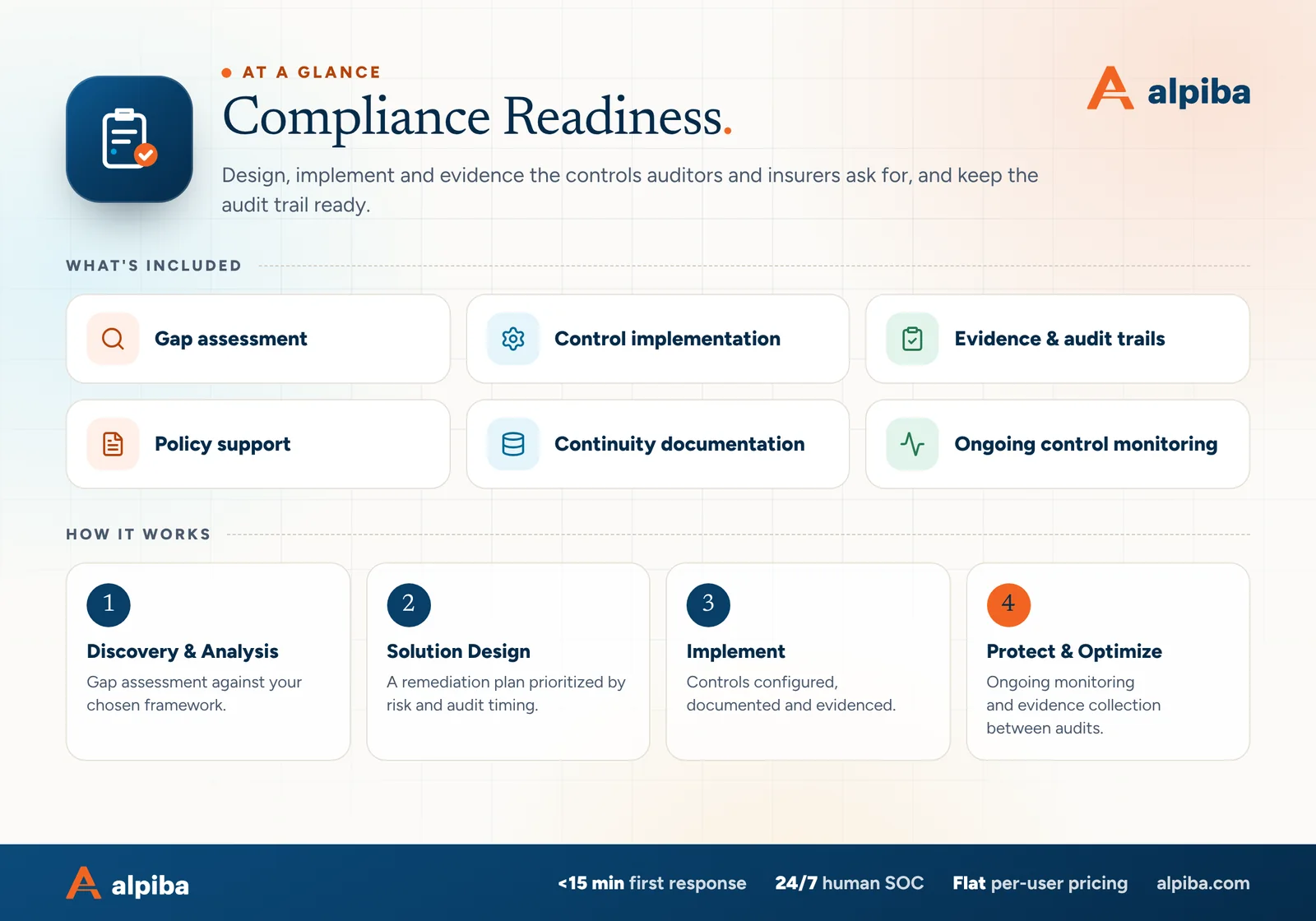
Agree what's in scope: systems, locations, people and data. Then compare current controls with the framework, control by control, and rank the gaps by risk and by audit timing.
Write or revise the core policies, such as access control, incident response, vendor management, backup and change management, so they describe what your team actually does. Short and true beats long and aspirational.
Configure and document MFA and conditional access, device encryption, logging, patching, backups and access reviews, with zero-trust identity controls as the foundation.
Gather screenshots, system exports, tickets, logs and training records as controls run, label them by control and date, and store them in one place.
Help you answer auditor requests, walk the auditor through technical controls and fix any findings. The auditor reaches its own conclusions.
How long readiness takes depends on the size of the gaps. A SOC 2 Type II report also needs a review period, often somewhere between three and twelve months, during which controls must operate consistently, so the report can't arrive before that period ends. Anyone who promises a date without seeing your environment is guessing.
Clear roles prevent the most common misunderstanding in compliance work: assuming the IT provider, or the auditor, owns the outcome.
| Task | Alpiba | Your organization | Auditor or assessor |
|---|---|---|---|
| Choosing the framework and scope | Recommends, based on who is asking | Decides and approves | Confirms scope in its engagement |
| Gap assessment | Performs and documents it | Provides access and answers | Separate from the audit itself |
| Policies | Drafts them to match your systems | Approves, adopts and follows them | Reviews them during testing |
| Technical controls | Implements, monitors and documents them | Owns risk decisions and exceptions | Tests their design and, for Type II, their operation |
| Evidence | Collects and organizes IT evidence | Provides HR, vendor and management evidence | Samples and tests it |
| Report or certificate | Helps answer requests and fix findings | Engages the auditor and owns the result | Issues its opinion, report or certificate |
Independence rules limit how much your audit firm can help build the controls it will later test, which is why readiness work and the audit are usually separate engagements. That separation protects the credibility of the report your customers will read. Some work also stays with you because no IT provider can do it for you: management review, HR processes such as background checks, and any decision to accept a risk rather than fix it.
Nobody can promise a clean audit, and HIPAA has no official certification to sell you. Results depend on how controls operate over time, and your organization remains responsible for its compliance.
Across frameworks, the same IT controls come up again and again. Here is what each one means in practice and what evidence of it usually looks like.

The scramble looks the same everywhere: two weeks before the audit, people screenshot everything, evidence dates cluster on the same few days, and gaps surface when there's no time left to fix them. A Type II report tests the whole review period, so a control that lapsed for three months shows up as an exception, whatever you do the week before.
| Area | Annual scramble | Continuous compliance |
|---|---|---|
| Evidence | Gathered in a rush before fieldwork | Collected as each control runs, dated and filed by control |
| Access reviews | Done once, under pressure | Done every quarter, with sign-off |
| Findings | Discovered by the auditor | Found and fixed internally first |
| Policies | Rewritten just before the audit | Updated when systems change |
| Questionnaires | Answered from scratch each time | Answered from a maintained evidence library |
| Staff time | Weeks of disruption | A small, steady monthly effort |
We build evidence collection into everyday IT work: reports generated on a schedule, changes recorded in tickets, restore drills documented each quarter, and open items reviewed at every quarterly business review. When fieldwork starts, most of what the auditor asks for already exists. The same library speeds up the security questionnaires that arrive between audits, because most of their questions map to controls you already evidence.
IT compliance services in San Diego have to fit the region's mix of industries. Biotech and life sciences cluster around Torrey Pines and Sorrento Valley, software companies in UTC, Carlsbad and Downtown sell to enterprises nationwide, dental and medical practices operate across the county, and tourism keeps a large number of merchants taking cards. Each group hears a version of the same question: can you prove your data is safe?
Hybrid work adds a wrinkle across the region. With so many teams split between home and office, auditors will ask how you secure laptops on networks you don't control, which is where device management, encryption and conditional access do the heavy lifting.
Defense subcontractors are a separate case: their contracts can impose specific requirements, so confirm those with the prime contractor and counsel before choosing a framework.

We don't publish prices because scope varies widely. These factors drive it:
Ongoing control monitoring and evidence collection fit into a flat, per-user monthly plan with no surprise line items. Readiness projects, such as a gap assessment and remediation push, are scoped separately after a free 30-minute assessment. Audit fees are separate too: you contract with the audit firm directly, which keeps the audit independent.
Put those questions to anyone offering IT compliance services in San Diego, including us. For an honest read on your gaps, book a free 30-minute assessment.
Talk to an engineer
Free 30-minute assessment. We reply within 12–24 hours.
“SMBs deserve a strategic technology partner, without enterprise complexity or cost.”
Roopa · Founder, Alpiba · former Accenture advisor
Alpiba is founder-led. Every Compliance Readiness engagement starts by listening to how your business runs, and senior engineers stay with you from the first call onward.

Free guide · PDF
Work out which framework you need, find your gaps and build evidence as you go, with a six-stage roadmap, a shared control map and a 90-day plan.
Get the free guide
Related services

Compliance & Risk
Scan and review systems, cloud settings and networks for weaknesses, then fix what matters most.

Infrastructure & Continuity
Immutable backups, tested restore plans and disaster recovery playbooks so your business stays online.

Cybersecurity
Identity-aware access, MFA everywhere and least privilege baked into every environment we manage.
Built for regulated teams
Free 30-minute assessment
Tell us about your business and what prompted the search. A senior engineer will reply within 12–24 hours to set up your free 30-minute assessment.

Founder-led and San Diego basedRoopa founded Alpiba to give growing businesses a real technology partner.