





On this page
Two businesses with the same headcount and the same Microsoft 365 licenses can need very different IT. A dental practice can't afford imaging downtime during patient hours. A law firm's biggest risk may be a spoofed payment request, and a biotech's may be research data leaving through a shared folder. Industry-specific IT services in San Diego start from those differences, then apply the same security-first foundation everywhere.
This guide covers why industry context changes priorities, how San Diego's industry mix shapes local risk, how the five industries we focus on compare, and what to do if yours isn't on the list.
Why industry context changes IT priorities
The building blocks barely change between industries: identity, devices, email, network, backups and monitoring. What changes is the order you tackle them in, how much downtime you can tolerate and who will ask you to prove your controls. Four questions usually reveal the difference.
- What must you protect? Patient records, privileged client files, research data, source code or production schedules. The answer decides where access controls and monitoring go first.
- How long can you be down? A full appointment book or a dock with trucks waiting measures downtime in minutes. That sets your recovery time objectives and how much redundancy is worth paying for.
- Who asks for proof? Regulators, auditors, enterprise customers, insurers and clients all send questionnaires. The frameworks they reference shape what evidence you keep.
- Which systems are special? Lab instruments, imaging software, case management tools and floor equipment often run software that's hard to patch, so they need isolation instead of the usual update cycle.
Whatever the industry, we start from MFA everywhere, managed EDR, immutable backups tested quarterly and 24/7 monitoring. Industry context changes the priorities on top of that foundation, never the foundation itself.
Regulated, data-sensitive or uptime-critical
Most businesses fit one or more of three profiles. Knowing yours is a quick way to see where IT effort pays off first.
A law or contract sets specific safeguards, such as HIPAA for patient data or PCI DSS for card payments. The priority is putting controls in place and keeping evidence ready, knowing that compliance remains your responsibility.
No single rulebook applies, but the data is the business: research IP, privileged files or source code. The priority is least-privilege access, data loss prevention and monitoring for unusual access or data movement.
Every hour offline stops revenue: chairs sit empty, lines stop and orders wait. The priority is resilient networks, documented recovery targets and backups proven by regular restore drills.
Plenty of businesses are two or three at once. A multi-location dental group is regulated and uptime-critical. A software company selling to enterprises is data-sensitive and, once customers start asking for SOC 2 reports, effectively audited too.
San Diego's industry mix and what it means for IT
San Diego County has a varied economy, and each cluster brings its own IT pressures. These are general patterns rather than rules, but they explain why the same checklist lands differently in Sorrento Valley than in Otay Mesa.
- Life sciences. Biotech and research teams cluster around Torrey Pines, Sorrento Valley and UTC, where partners, investors and acquirers often send security questionnaires before they share data or money.
- Technology and software. Hybrid and remote-first teams sell to enterprise buyers who expect strong identity controls and, increasingly, a SOC 2 report.
- Manufacturing, logistics and cross-border trade. Plants and distribution sites, including those moving goods through Otay Mesa, depend on warehouse Wi-Fi, connected equipment and systems that simply can't stop.
- Professional and dental practices. Law firms around Downtown San Diego and dental offices across the county handle confidential or regulated data, often without full-time IT staff.
Add the region's defense and maritime presence, its tourism and hospitality sector and a workforce that's often hybrid, and the common thread is clear: sensitive work now happens in cloud accounts and on laptops far from any one office. That's why every industry plan we build starts with identity.
The five industries at a glance
Each industry page goes deep on one sector. This table puts the main risks, frameworks and first priorities side by side.
| Industry | Main risks | Frameworks that often come up | Where we usually start |
|---|---|---|---|
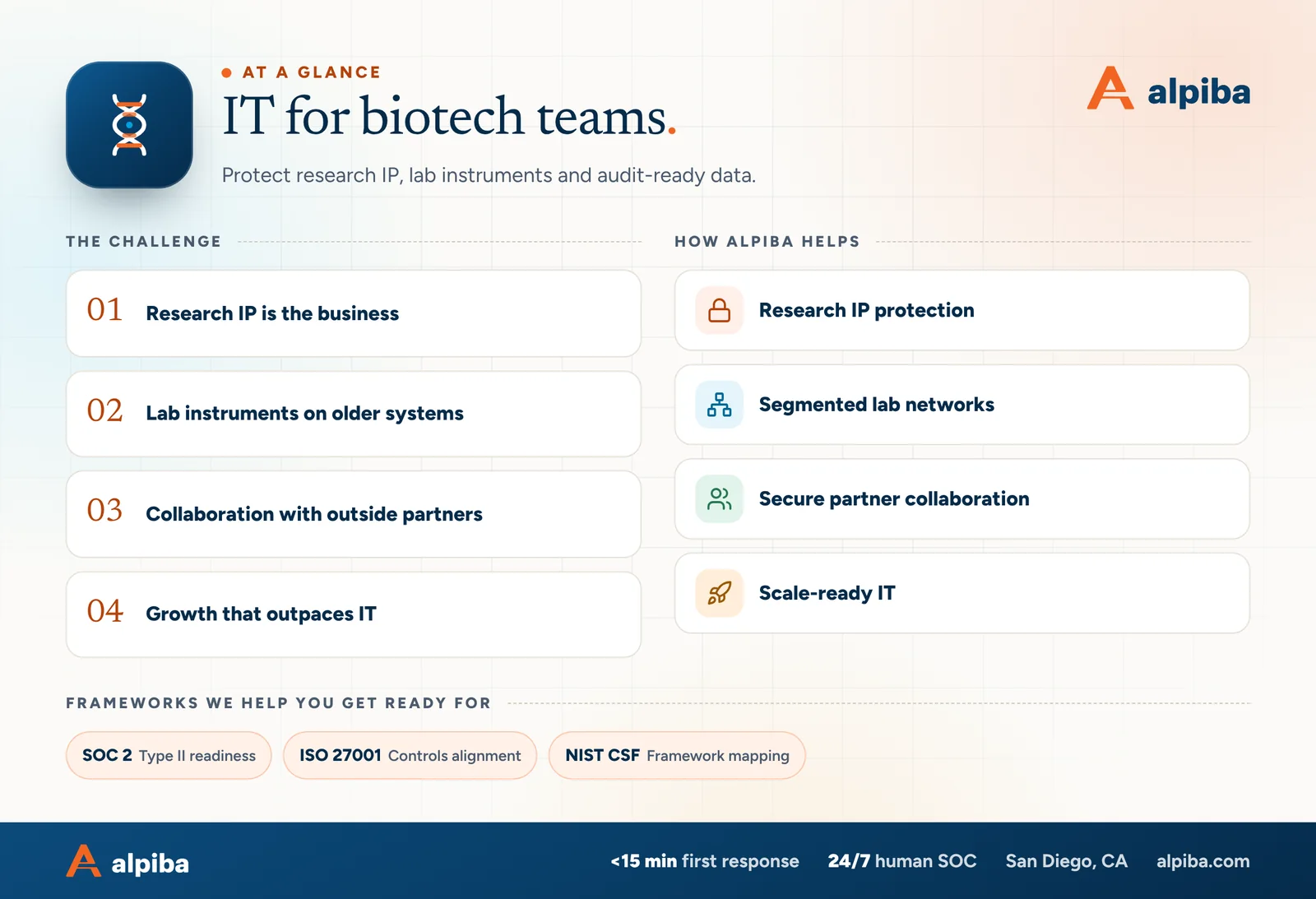
| Biotech & life sciences | Research IP theft, unpatchable lab instruments, partner data sharing, growth outpacing IT | SOC 2 Type II readiness, ISO 27001 controls alignment, NIST CSF mapping | Zero-trust access and segmented lab networks |
| Law firms | Email fraud and impersonation, exposure of privileged files, case and document tool downtime | NIST CSF, ISO 27001 and SOC 2 controls behind client questionnaires | Email security, MFA everywhere and least-privilege access to matters |
| Manufacturing & logistics | Ransomware that stops production, hard-to-patch equipment, warehouse coverage, multi-site networks | NIST CSF mapping, ISO 27001 controls alignment | Network segmentation and tested backups for business systems |
| Software & technology | Stalled enterprise deals, developer access, SaaS sprawl, laptops shipped to remote hires | SOC 2 Type II readiness, ISO 27001, NIST CSF | Identity controls and a SOC 2 gap assessment |
| Dental | Patient data under HIPAA, imaging and practice management downtime, ransomware, multiple locations | HIPAA aligned safeguards, PCI DSS merchant readiness | HIPAA-aligned safeguards and immutable, tested backups |
Read the details for biotech and life sciences, law firms, manufacturing and logistics, software and technology or dental practices.
We implement and evidence the technical controls a framework expects. Auditors issue the reports, and compliance remains your organization's responsibility. Framework references describe readiness for your environment, not certification of Alpiba.
Signs your IT fits your industry
Whatever your sector, these are the marks of an environment shaped by the work it supports. If you can't tick most of them, industry context hasn't made it into your IT yet.
- You can name the data that matters most and everyone who can reach it
- Recovery targets for your critical systems are written down and tested
- Systems that can't be patched sit on their own network segment
- You can answer a security questionnaire with evidence, not guesses
- Someone watches alerts at night and on weekends, not just in business hours
- Access is removed the same day someone leaves
- Your specialist software vendors have a named contact who escalates on your behalf

If your industry isn't listed
We go deep on five industries, but the approach isn't limited to them. You don't need a page of your own to benefit from industry-specific IT services in San Diego. If you handle sensitive data, answer to an auditor or insurer, or lose money every hour systems are down, the same method applies.
- Accounting, finance and insurance offices share most of the law firm playbook: confidential client files, payment fraud and client security questionnaires.
- Medical, therapy and specialty clinics share much of the dental playbook: patient data, scheduling uptime and HIPAA-aligned safeguards.
- Construction, engineering and field-service firms share manufacturing and logistics needs: several sites, devices in the field and schedules that slip when systems stop.
- Hospitality, retail and other card-taking businesses need PCI DSS merchant readiness and guest Wi-Fi kept apart from staff and payment systems.
- Find your closest match
Read the industry page whose risks look most like yours and note which priorities apply.
- Check your baseline
Run the security health check: ten questions across five core areas, in about two minutes.
- Tell us what's different
In a free 30-minute assessment we ask about your data, downtime tolerance and who asks you for proof, then shape the plan around the answers.
Questions to ask any IT partner about your industry
Good answers to these questions are specific to your systems and your obligations. Vague answers tell you something too.
- Which of our systems are hardest to patch, and how would you protect them?
- What recovery time would you design for our most critical system, and how would you prove it works?
- Which frameworks or questionnaires do businesses like ours face, and what evidence would you keep for us?
- Who watches our alerts at night, on weekends and on holidays?
- How do you work with our specialist software vendors when something breaks?
- What would you fix in the first 90 days, and what can safely wait?