<4 hrs
Recover in hours
Typical recovery time objective under 4 hours.
SOC online 24/7Breach or outage? Call 858-399-4225
Free guidesinfo@alpiba.comMon–Fri, 7am–7pm PT

Infrastructure & Continuity
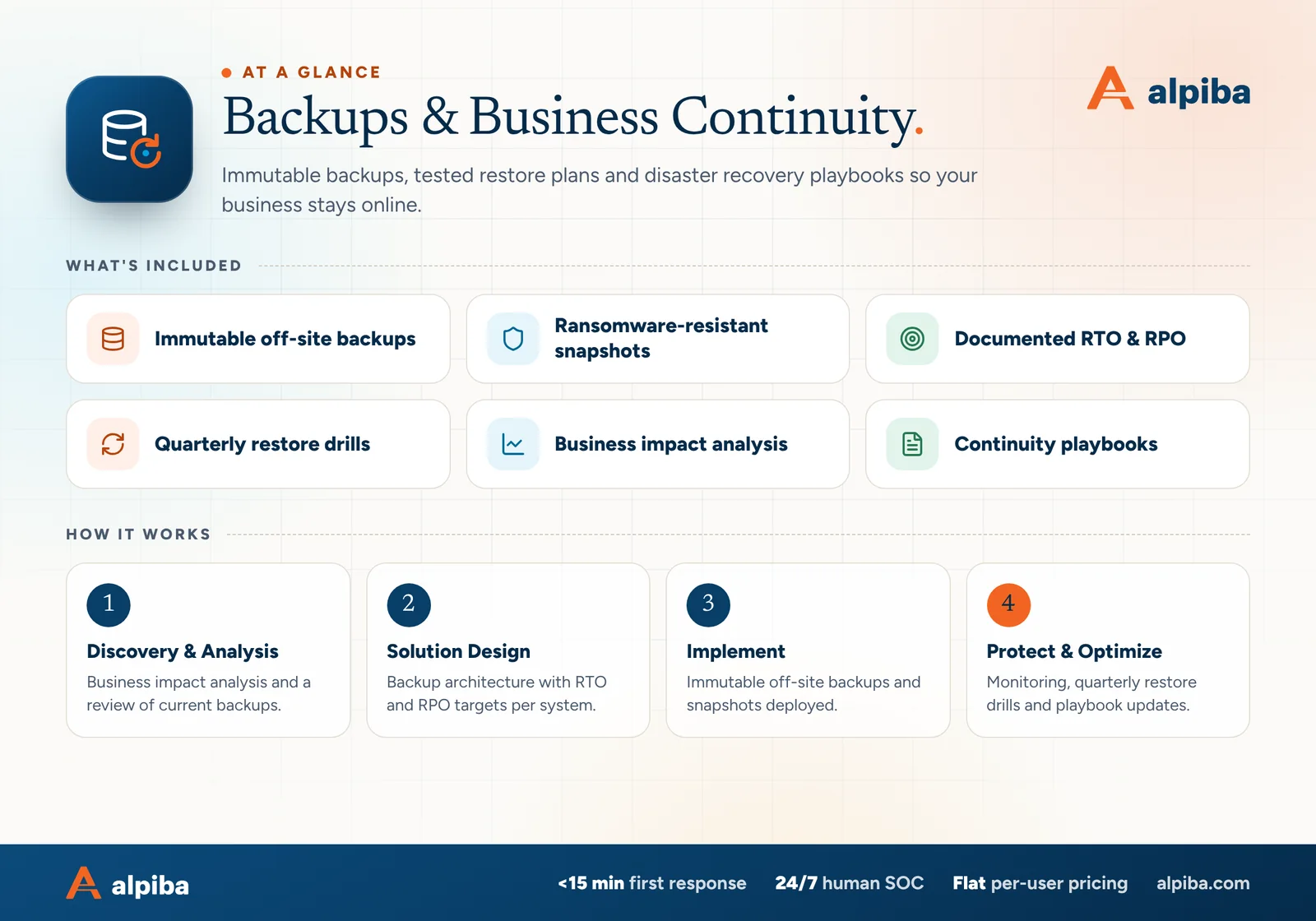
A backup you haven't tested is just a hope. We build off-site backup systems with immutability and rehearse restores every quarter, so recovery is routine, not a gamble.
<15 min average first response Flat per-user pricing Free guide: The San Diego Business Continuity Workbook

The complete guide
Every business has backups until the day it needs one. That day might bring a ransomware note on the file server, a Microsoft 365 mailbox emptied through a compromised account, a server that won't start after a weekend power flicker, or an SDG&E shutoff that darkens the office for two days. Backup and disaster recovery in San Diego has to answer three plain questions before then: what exactly is protected, how long will it take to get it back, and how do you know it works?
We build immutable off-site backups, document recovery targets for each system and rehearse restores every quarter. Our typical recovery time objective is under 4 hours, and your actual targets are written down system by system, because a typical figure is not a promise about your environment.
This page covers the 3-2-1 approach and why immutability matters now, RTO and RPO in plain English, how a business impact analysis sets priorities, what a continuity plan should say, and how to prepare for wildfire season, power shutoffs and earthquakes across San Diego County.
The three terms get used interchangeably, but they answer different questions, and the gaps between them are where recoveries go wrong.
Copies of your data, taken on a schedule and stored somewhere safe. On its own, a backup says nothing about how long recovery will take.
The tested process for restoring systems after a major incident, measured against recovery time and recovery point targets. It covers the order of restores, who does them and where systems come back.
How the business keeps serving customers while systems are down, through workarounds, alternate locations and clear communication. It involves everyone, not just IT.
A business can have flawless backups and still be down for a week: nobody knows the restore order, the only hardware to restore onto is the encrypted server, or the license keys lived on the machine that died. Good planning covers the whole path from incident to normal operations.
The classic rule of thumb is 3-2-1: keep at least three copies of your data, on two different types of storage, with one copy off-site. It was designed for hardware failure, fire and theft, and it still handles them well.
Ransomware changed the threat. Attackers who gain administrator access look for backups and try to delete or encrypt them before they launch, so a copy that an admin account can erase isn't a safe copy. At least one copy needs to be an immutable backup: once written, it can't be changed or deleted until its retention period ends, even with valid admin credentials. Here is how the layers fit together:
Microsoft and Google run the platforms, but the data in them is yours to protect. The risks are ordinary: a departing employee deletes a project folder, a compromised admin account purges mailboxes, a laptop syncs ransomware-encrypted files over good ones, or a retention policy is set up wrong and nobody notices for months. Built-in recycle bins only reach back so far, so we back up mailboxes, shared drives and sites to a separate, immutable store, whether you run Microsoft 365 or Google Workspace.
Sync tools copy every change everywhere within seconds, including deletions and files ransomware has just encrypted. A synced folder, or a USB drive that stays plugged in, is not a recovery plan.
Recovery time objective (RTO) is how long a system can be down before the damage becomes unacceptable. Recovery point objective (RPO) is how much recent work you can afford to lose, measured in time. A server backed up nightly has an RPO of up to 24 hours: a failure at 5pm can take the whole day's work with it.
Shorter targets cost more. A shorter RPO means more frequent backups or replication, and a shorter RTO means faster restore paths or standby systems. Setting targets per system lets you spend where downtime really hurts and save where it doesn't. Very short RPOs usually call for replication, which copies changes to a second system almost continuously. It copies mistakes and encryption just as quickly, so it complements immutable backups rather than replacing them.
| System | What stops when it fails | Target RTO | Target RPO |
|---|---|---|---|
| Scheduling, case or job management server | Bookings, billing and client records | 4 hours | 1 hour |
| Shared files | Most day-to-day work | 4 hours | 1 hour |
| Email and calendar (cloud) | Client contact, if mail is deleted or an account is compromised | 8 hours | 24 hours |
| Accounting | Payroll and payables, worst at month-end | 24 hours | 24 hours |
| Archived projects | Nothing day to day | 72 hours | 24 hours |
Fill in the same table for your own systems and add an owner to each row. If every row says one hour, start again: that isn't a plan, it's a budget request. We agree and document targets for each system during onboarding, then test against them in every drill.
A business impact analysis (BIA) is a structured conversation with the people who run each part of the business. It identifies which processes matter most, what they depend on, how quickly harm grows once they stop and when an outage would hurt most, such as month-end close or the week before a filing deadline.
Start with processes, not servers: taking orders, seeing patients, billing, payroll, shipping, filing.
Note every system, vendor and key person it needs, including the easy-to-forget ones such as sign-in, internet access and the phone carrier.
Consider lost revenue, missed deadlines, regulatory exposure and customer trust after an hour, a day and a week. Our downtime cost calculator helps put figures on the first hours.
Assign RTO and RPO per system, then sequence recovery so dependencies come first: identity and network, then the systems customers feel, then everything else.
Leadership approves the targets and the budget behind them. Revisit the BIA every year and after major changes, such as a new office or a new core application.
The output is short: a ranked list of systems with targets and owners, and a restore order everyone agreed to before an incident rather than during one.
A backup you haven't tested is just a hope. Backup software reports success when a job finishes, not when a restore works, so the only way to know you can recover is to recover. We rehearse restores every quarter and record what happened. A drill covers:
Drills also catch the quiet failures: a new server that was never added to the backup, an expired license on the backup software, or retention that was shortened during a cleanup and never restored.
The reports are useful evidence. Cyber insurers often ask whether backups are immutable and when restores were last tested, and SOC 2, ISO 27001 and HIPAA all address backup and recovery testing. If you're preparing for an audit, our compliance readiness work draws on the same reports.
Restoring one file proves the backup job ran. Restoring the server behind your scheduling system, and timing it, proves you could reopen on a bad Monday.

Ransomware recovery differs from replacing a failed disk. You have to assume the attacker had access for a while, so you restore into a clean environment, choose a recovery point from before the intrusion (which may be well before the files were encrypted), and confirm the attacker's access is gone before reconnecting anything. The order matters:
Whether to pay a ransom is a decision for leadership, counsel and your insurer, and immutable backups are what make it possible to say no. Prevention is the other half of the story, covered on our ransomware defense page.
A continuity playbook should be short enough to use under stress, printed, and kept where you can reach it when the office is dark and the network is down. Business continuity planning in San Diego should also assume that some staff can't get to the office at all. The plan should cover:
In the first hours, say what you know, what you're doing and when the next update will come. Don't speculate about data exposure. If personal or patient information may be involved, California's breach notification law and, for healthcare providers, HIPAA's Breach Notification Rule may apply, so bring in counsel early and let them guide what you say externally.
Backup and disaster recovery in San Diego has to account for a few local realities. None of them are exotic; they're the predictable ways a region with dry fall winds, a major fault and a large hybrid workforce gets disrupted.
Several of these depend on how your infrastructure is built: UPS sizing, dual internet circuits and secured server racks. Our network and server design work covers that side, so the backup plan and the infrastructure are designed together.

We don't publish prices, because the right design depends on how much data you have and how quickly you need it back. The main cost drivers are:
Ongoing work, including backup monitoring, quarterly restore drills and playbook updates, is part of a flat, per-user monthly plan with no surprise line items. Larger one-time projects, such as replacing a backup platform, are scoped separately.
Ask those questions of anyone offering backup and disaster recovery in San Diego, including us. A free 30-minute assessment is a quick way to find out where you stand.
Talk to an engineer
Free 30-minute assessment. We reply within 12–24 hours.
“SMBs deserve a strategic technology partner, without enterprise complexity or cost.”
Roopa · Founder, Alpiba · former Accenture advisor
Alpiba is founder-led. Every Backups & DR engagement starts by listening to how your business runs, and senior engineers stay with you from the first call onward.

Free guide · PDF
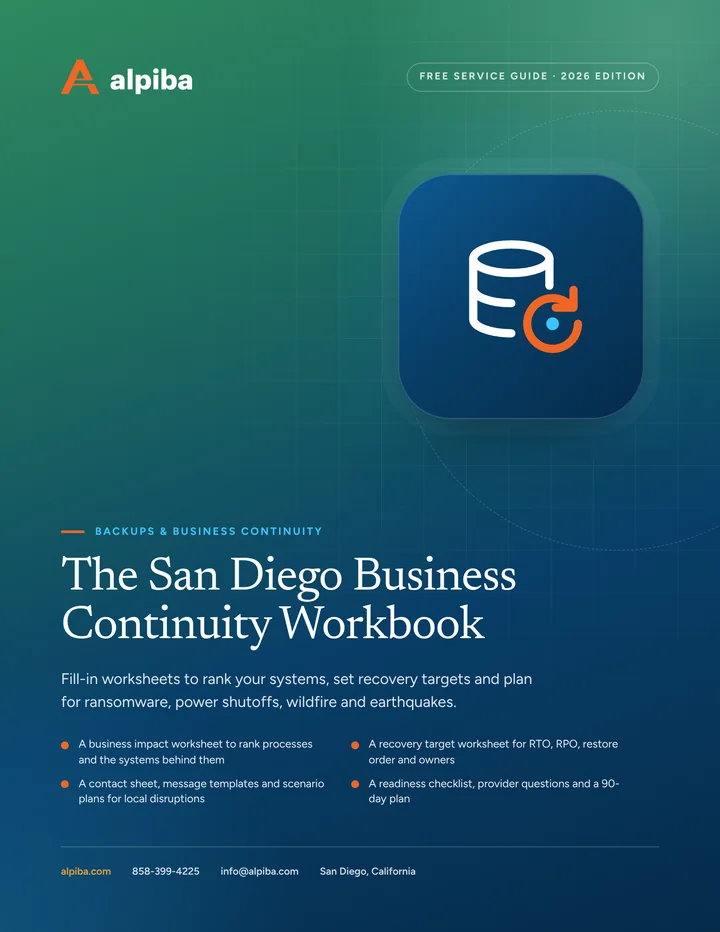
A printable workbook that turns a vague intention into a written plan your team can actually follow on a bad day.
Get the free guide
Related services

Cybersecurity
24/7 monitoring, threat hunting and rapid incident response that contains attacks before they impact your business.
Infrastructure & Continuity
Design, optimize and secure your infrastructure for maximum uptime and performance.

Compliance & Risk
Design, implement and evidence the controls auditors and insurers ask for, and keep the audit trail ready.
Built for regulated teams
Free 30-minute assessment
Tell us about your business and what prompted the search. A senior engineer will reply within 12–24 hours to set up your free 30-minute assessment.

Founder-led and San Diego basedRoopa founded Alpiba to give growing businesses a real technology partner.