Decisions with context
Every IT purchase is tied to a goal, a risk or a requirement.
SOC online 24/7Breach or outage? Call 858-399-4225
Free guidesinfo@alpiba.comMon–Fri, 7am–7pm PT

Managed IT
SMBs deserve a strategic technology partner without enterprise complexity or cost. We build a roadmap sized to your operations, budget and growth, then review it with you every quarter.
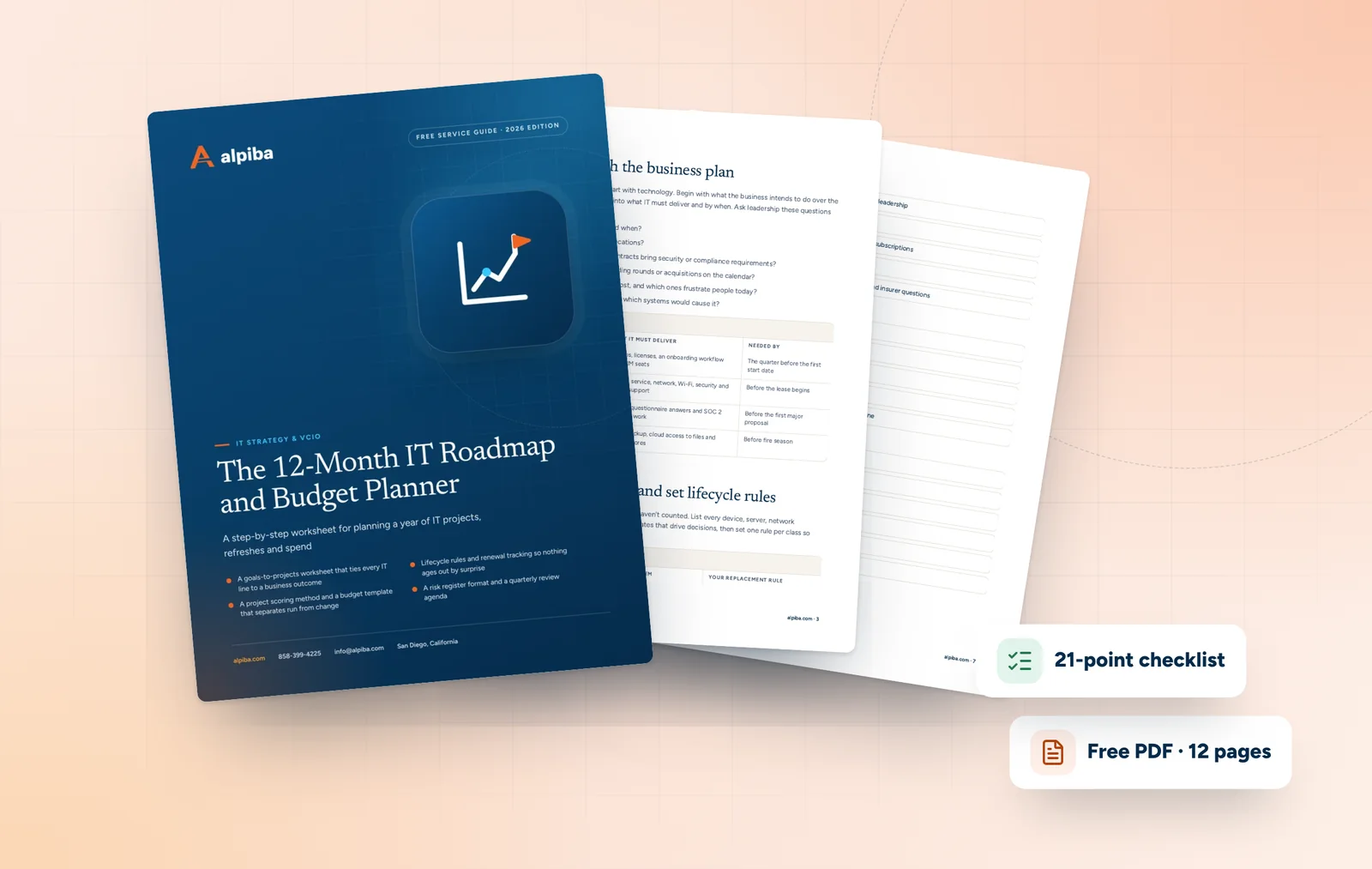
<15 min average first response Flat per-user pricing Free guide: The 12-Month IT Roadmap and Budget Planner

The complete guide
Most growing businesses don't need a full-time chief information officer. They do need someone who knows what is up for renewal next quarter, which laptops are aging out, where the real security risks sit and how all of it maps to the growth plan. Providing exactly that is the point of our vCIO services in San Diego: a virtual CIO who turns technology from a stream of surprises into a 12-month roadmap and budget, reviewed with you every quarter.
The approach borrows from enterprise practice, where Alpiba's founder spent years advising large organizations on strategy and cybersecurity. The frameworks are the same ones big companies rely on. The paperwork is sized for a 30-person firm, and every recommendation is written so a busy owner can read it in minutes.
This page explains what a vCIO does each quarter, how the roadmap and budget are built, how lifecycle planning and risk registers work, and how to tell whether you need one.
A virtual CIO is a fractional technology leader. The helpdesk fixes today's problems; the vCIO decides what next year should look like, what it will cost and which risks are worth paying to reduce. You get the planning discipline of a CIO without a full-time executive salary.
Our vCIO services in San Diego suit owners, CFOs and COOs who sign off on IT spending but have no wish to become technologists. That might be a software company in UTC fielding enterprise security questionnaires, a dental group adding a location in Chula Vista, or a North County manufacturer replacing an aging ERP system.
Strategy only works if it has a rhythm. Ours is the quarter: long enough to finish meaningful work, short enough that the plan never drifts far from reality.
Ticket trends, incidents, security findings, asset ages, license counts, upcoming renewals and spend against budget are pulled together before the meeting.
A short written summary goes out ahead of time, so the meeting is spent on decisions rather than on reading slides.
Together we walk through roadmap progress, incidents since the last review, changes in risk and spend against budget, then set next quarter's priorities. A short, plain-English summary follows.
The roadmap, budget and risk register are revised, and every approved project gets an owner, a date and a definition of done.
We run or coordinate the projects, handle renewals and raise anything that changes the plan as soon as it appears, not at the next review.
| Quarter | Main focus | What you leave with |
|---|---|---|
| First | Lock the year's priorities and budget | An approved roadmap with owners and dates |
| Second | Security and resilience check | An updated risk register, restore drill results and the status of insurance or compliance evidence |
| Third | Lifecycle and renewals | Next year's refresh list and renewal decisions |
| Fourth | Next year's plan | A draft 12-month roadmap and budget for leadership sign-off |
Every review still covers progress, incidents, risk and spend. The rotating focus simply makes sure the big annual decisions happen on time, instead of the week before a renewal.
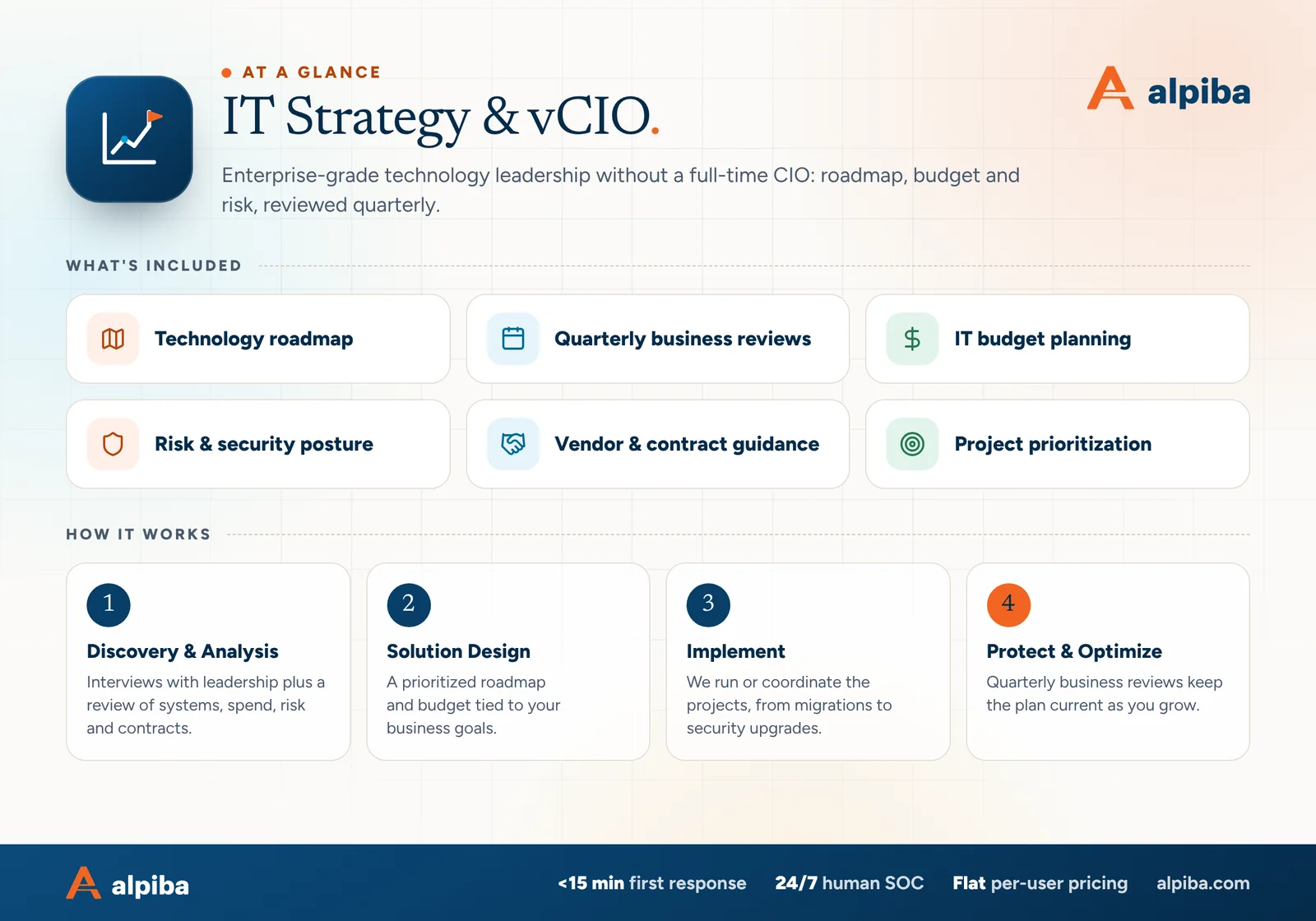
A roadmap starts with the business plan, not with technology. We begin with interviews with leadership and a review of systems, spend, risk and contracts, then work through six steps.
Keep recurring costs and one-time projects on separate lines. It turns the “why did IT go up?” conversation from an afternoon into five minutes.
Every asset has a life: purchase, warranty, end of vendor support, replacement. Software has one too. When Microsoft ended support for Windows 10, businesses with a lifecycle plan had already budgeted their replacements; others found out from a security scan or an insurance questionnaire.
| Asset | What goes wrong without a plan | What the plan does instead |
|---|---|---|
| Laptops | Half the fleet ages out in the same year and slows everyone down | Replaces a share of devices each year at a set age |
| Servers and storage | Vendor support ends and the server keeps running, unpatched | Schedules a replacement or cloud move before support ends |
| Firewalls and Wi-Fi | Security subscriptions lapse and protection quietly stops | Tracks firmware support and subscription renewals |
| Software and SaaS | Unused seats auto-renew for another year | Reviews usage before each renewal notice period |
| Domains and certificates | The website or email breaks on expiry day | Turns on auto-renew and names an owner |
| Cyber insurance | The renewal questionnaire asks for controls you don't have | Starts preparation at least a quarter ahead |
Warranty and support are different dates. A warranty covers hardware repairs; vendor support covers the security updates that keep a device safe to use. A server out of warranty is an inconvenience, while a server out of support is a risk, so track both.
Pick a replacement age for each class and write it down. If laptops are replaced at four years, budget for roughly a quarter of the fleet every year instead of all of it at once. Our procurement and renewal tracking then turns the plan into orders, configured devices and renewals that never arrive as surprises.
A risk register is a short list of what could hurt the business, how likely and how serious each item is, who owns it and what happens next. Large enterprises run on them. Smaller businesses often don't keep one, so risk decisions get made by whoever is loudest after an incident.
| Risk | Likelihood / impact | Owner and next step |
|---|---|---|
| Firewall managed through a shared admin login without MFA | Medium / High | IT lead: named accounts with MFA this quarter |
| Only one person knows how the lab instrument PCs are configured | High / Medium | Lab manager: document and cross-train next quarter |
| Accounting system backups have never been restore-tested | Medium / High | Alpiba: restore drill before the year-end close |
| Enterprise customers asking for SOC 2 readiness | High / High | COO: readiness project added to the roadmap |
We map entries to the six functions of the NIST Cybersecurity Framework 2.0 (Govern, Identify, Protect, Detect, Respond and Recover), so leadership can see whether gaps cluster in prevention, detection or recovery. Findings from vulnerability assessments feed straight into the register, ranked by business impact rather than by technical score alone.
Growth breaks informal IT. The roadmap's job is to see each milestone coming and have the technology ready before the business needs it.
Network, security and on-site support should be ready before the lease starts. A new office in Carlsbad or Chula Vista goes on the roadmap as soon as the lease is discussed.
Growing from 25 to 50 people breaks onboarding that lives in someone's head. Standard devices, license planning and a written workflow arrive ahead of the hiring wave.
Enterprise buyers send security questionnaires and may ask about SOC 2. Readiness takes quarters, so it starts before a deal depends on it.
Investors and buyers ask about cyber risk, data ownership and IT contracts during due diligence. A current risk register and asset inventory answer most of it.
Copilot and Gemini can only see what each user can see. Clean up file permissions and data access before switching them on.
Biotech teams around Torrey Pines and Sorrento Valley need instrument PCs, data storage and network segmentation planned with the move. Retrofitting them afterward costs time the science can't spare.
Two services often appear in these plans. Compliance readiness prepares and evidences the controls behind SOC 2, HIPAA or ISO 27001 alignment; auditors issue the reports, and the obligations remain yours. Secure AI and automation helps teams adopt copilots and agents without exposing data they shouldn't.
Boards and investors don't want ticket counts. They want to know whether the business is exposed, whether the plan is on track and what they need to decide. A good IT report fits on one page.
We help you prepare evidence for SOC 2, HIPAA or insurer questionnaires. Auditors issue the reports and compliance obligations stay with your business, so a good board report says plainly which is which.
Fundraising, acquisitions and enterprise sales all bring long questionnaires about how you protect data. The same questions repeat: where data lives, who can access it, whether MFA is enforced, how backups are tested, what incidents have occurred and which vendors hold your data. Keeping those answers current in one place turns a two-week scramble into an afternoon.
When a board member asks whether ransomware could stop the business, the honest answer depends on recovery time and tested restores, not on how many tools you own. Our downtime cost calculator helps put a number on that conversation before anyone has to learn it the hard way.
Roopa, Alpiba's founder, learned early, inside corporate IT departments, that good technology decisions quietly compound and bad ones quietly bleed. Recruited by Accenture in 2018, she spent years advising large enterprises on strategy, cybersecurity and digital transformation, where written roadmaps, formal risk management and disciplined prioritization are simply how work gets done.
Alpiba exists to give smaller businesses that same discipline, delivered with the responsiveness and directness of a boutique firm. Her view is simple: “SMBs deserve a strategic technology partner, without enterprise complexity or cost.”
Alpiba's leadership brings 25+ years in technology, 100+ successful technology initiatives, $100M+ in technology programs managed, 10,000+ end users supported, and Fortune 500 and public sector experience. You can read more about Roopa and why she started Alpiba.
You may not need a vCIO yet if your team is small and stable, with no growth, audit or funding events ahead. These are the signs that the time has come.
If every item on a roadmap is something the provider sells, it is a sales plan. A real roadmap includes changes that cost nothing, such as retiring a tool, consolidating licenses or fixing a process.
Our vCIO services in San Diego are priced the same way as the rest of our work. Quarterly business reviews are part of every managed IT engagement, under flat, per-user monthly pricing with no surprise line items. The depth of strategy work you need, from board reporting to due diligence support, is scoped during a free 30-minute assessment, and projects that come out of the roadmap are quoted and approved before they start.

Talk to an engineer
Free 30-minute assessment. We reply within 12–24 hours.
“SMBs deserve a strategic technology partner, without enterprise complexity or cost.”
Roopa · Founder, Alpiba · former Accenture advisor
Alpiba is founder-led. Every IT Strategy & vCIO engagement starts by listening to how your business runs, and senior engineers stay with you from the first call onward.

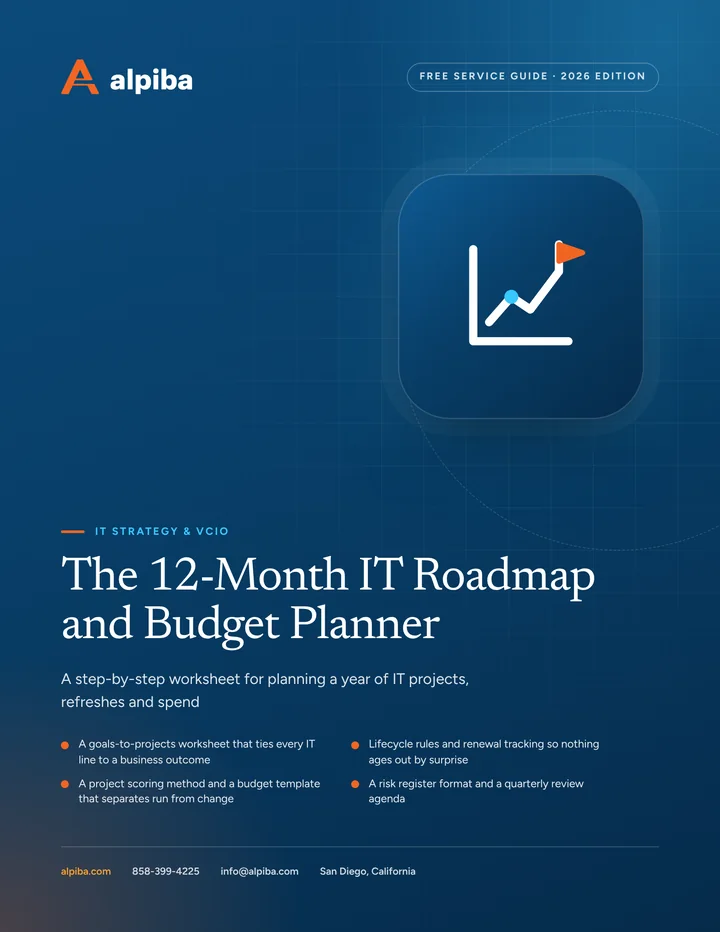
Free guide · PDF
Plan a full year of IT in a few working sessions: tie projects to business goals, schedule lifecycle replacements, build a predictable budget and report progress every quarter.
Get the free guide
Related services

Managed IT
Your single point of contact for all technology, with a tailored helpdesk and on-site support backed by clear SLAs.

Compliance & Risk
Design, implement and evidence the controls auditors and insurers ask for, and keep the audit trail ready.

Cloud & Productivity
Adopt AI agents and copilots with the same security-first discipline we bring to everything else.
Built for regulated teams
Free 30-minute assessment
Tell us about your business and what prompted the search. A senior engineer will reply within 12–24 hours to set up your free 30-minute assessment.

Founder-led and San Diego basedRoopa founded Alpiba to give growing businesses a real technology partner.