SOC online 24/7Breach or outage? Call 858-399-4225

Free guidesinfo@alpiba.comMon–Fri, 7am–7pm PT

Alpiba

Free service guide · PDF

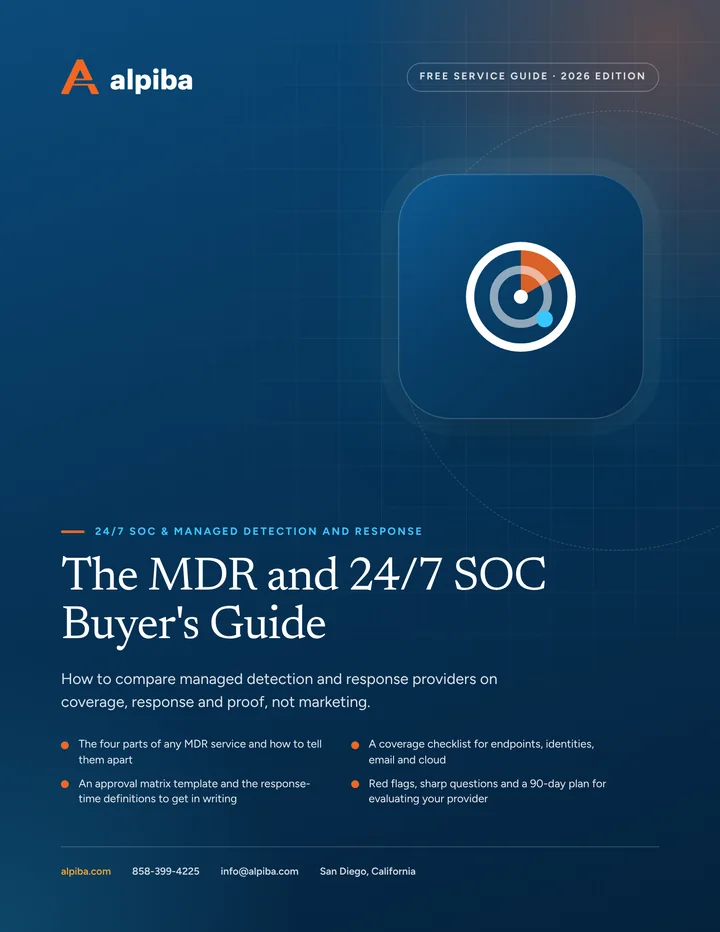
The MDR and 24/7 SOC Buyer's Guide

How to compare managed detection and response providers on coverage, response and proof, not marketing.

  • The four parts of any MDR service and how to tell them apart
  • A coverage checklist for endpoints, identities, email and cloud
  • An approval matrix template and the response-time definitions to get in writing
  • Red flags, sharp questions and a 90-day plan for evaluating your provider

11 pages23-item checklist30/60/90-day plan

Cover of The MDR and 24/7 SOC Buyer's Guide

Get your free copy

Instant PDF download. No sales pitch inside.

Instant download. By submitting, you agree that Alpiba may contact you about this guide; you can ask us to delete your details at any time.

Cover and two sample pages of The MDR and 24/7 SOC Buyer's Guide, a free 11-page PDF guide from Alpiba with a 23-point checklist
A look inside: the cover and two pages from the 11-page PDF.

What's inside

Inside the guide.

MDR proposals tend to look alike: 24/7 monitoring, AI-driven detection, rapid response. The differences that matter sit underneath: what is actually monitored, who is watching at 2am, what they're allowed to do without calling you and what you get in writing afterward.

This guide helps you compare providers on those points, including us. Use the sections to understand what you're buying, the checklist to line proposals up side by side and the questions in sales meetings. The 90-day plan helps you judge a provider after you sign, while it's still early enough to fix problems.

  1. What you're actually buying
  2. Coverage: what must be watched
  3. Response: put speed and authority in writing
  4. Reporting and proof
  5. Red flags
  6. The checklist23 items in 4 groups
  7. Questions to ask any IT provider10 questions
  8. Your 30/60/90-day plan3 phases, step by step
  9. Plain-English glossary8 terms

Read Part 1 free

The opening chapter of the guide, in full. The rest of the guide, the checklist and the 90-day plan are in the PDF.

What you're actually buying

Every MDR service combines four things, and a weakness in any one of them limits the rest.

The four parts of an MDR service
PartWhat it meansWhat to look for
CoverageThe systems and signals being monitoredEndpoints, identities, email and cloud, confirmed against your inventory
PeopleWho reviews alerts and investigatesHuman analysts around the clock, not just automated notifications
Response authorityWhat the provider can do when it finds somethingAgreed actions such as isolating devices and disabling accounts
ReportingHow you learn what happenedPlain-English incident timelines and regular coverage reviews

Offers usually fall into one of three models, and the difference shows up at 2am:

Three common service models
ModelWhat you getWho acts at 2am
Tools onlySoftware licenses and a console to watchYour own team, if anyone is awake
Alert monitoringSomeone watches and forwards alerts to youUsually your team, after an email or a call
MDRMonitoring, investigation and agreed responseThe provider's analysts, within your approval matrix

Be careful with services that monitor but don't respond. Forwarding an alert by email leaves the hardest part, deciding and acting, with your team in the middle of the night.


Get the full guide

A preview

A sample from the guide.

Here's the first checklist group and a few of the questions. The full guide has all 23 checklist items, 10 questions and the 90-day plan.

Coverage

  • EDR agent on every laptop and server, matched to the inventory
  • Identity and sign-in monitoring for every account, including admins
  • Email threats and user-reported messages reviewed by analysts
  • Microsoft 365 or Google Workspace audit logs connected
  • Compensating controls for systems that can't run an agent
  • Log retention set to meet insurer, audit and contract needs

Questions to ask any IT provider

  1. 1Who staffs your SOC overnight, and are they your employees or a partner's?
  2. 2How do you define first response, and what was your average last quarter?
  3. 3Which actions can your analysts take without calling us?
  4. 4Which data sources are included in the price, and which cost extra?

+ 6 more questions in the full guide

24/7 SOC & Managed Detection and Response at a glance. Included: 24/7 alert monitoring & triage, SIEM & log correlation, EDR / XDR response, Identity & sign-in monitoring, Proactive threat hunting and Plain-language reporting. How it works: Discovery & Analysis, Solution Design, Implement and Protect & Optimize.
24/7 SOC & MDR at a glance: what is included and how we roll it out.

Your first 30 days

Where to start this month.

The guide's 30/60/90-day plan begins with these steps. Assign an owner to each and review progress every two weeks.

  • 1Share your asset inventory and confirm agent coverage device by device
  • 2Agree the approval matrix and contact ladder
  • 3Connect identity, email and cloud audit logs
  • 4Document travel patterns, scheduled jobs and authorized tools

Key terms in plain English

SOC
Security operations center: the team that monitors alerts, investigates and responds, often around the clock.
MDR
Managed detection and response: a service combining monitoring tools with people who investigate and contain threats for you.
SIEM
A platform that gathers logs from many systems and correlates them so related events can be investigated together.
XDR
Extended detection and response: detection that links endpoint, email, identity and cloud signals into one view.
Telemetry
The stream of activity data that systems send to security tools, such as sign-ins, process activity and audit logs.
False positive
An alert triggered by harmless activity. Tuning reduces them so real threats stand out.
Threat hunting
Analysts proactively searching for signs of an attacker that automated detections haven't caught.
Approval matrix
A written agreement on which response actions a provider can take immediately and which need your sign-off.
Roopa, founder of Alpiba

SMBs deserve a strategic technology partner, without enterprise complexity or cost.RoopaFounder, Alpiba

Put the guide to work

Services that help you act on it.

All services
A close view of a glowing circuit board

Cybersecurity

Cybersecurity & Ransomware Defense

24/7 monitoring, threat hunting and rapid incident response that contains attacks before they impact your business.

A padlock resting on a laptop keyboard

Cybersecurity

Zero Trust & Identity Security

Identity-aware access, MFA everywhere and least privilege baked into every environment we manage.

Keep reading

More free guides.

All guides
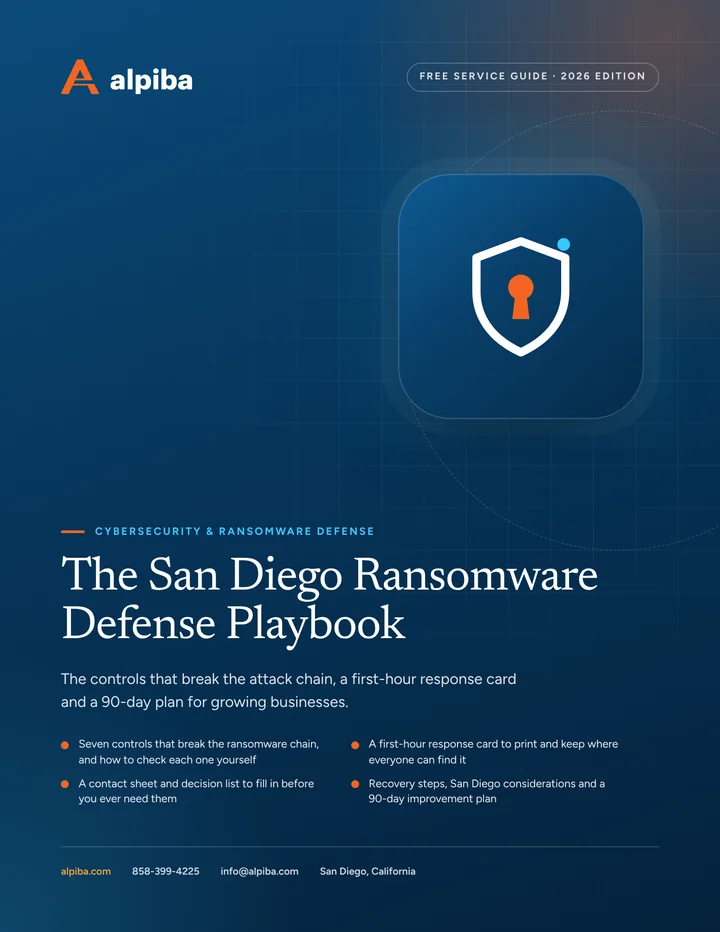
Cover of The San Diego Ransomware Defense Playbook

Service guide · Cybersecurity

The San Diego Ransomware Defense Playbook

A printable playbook for business owners and the people who run their offices and IT: what to put in place before an attack, what to do in the first hour and how to recover.

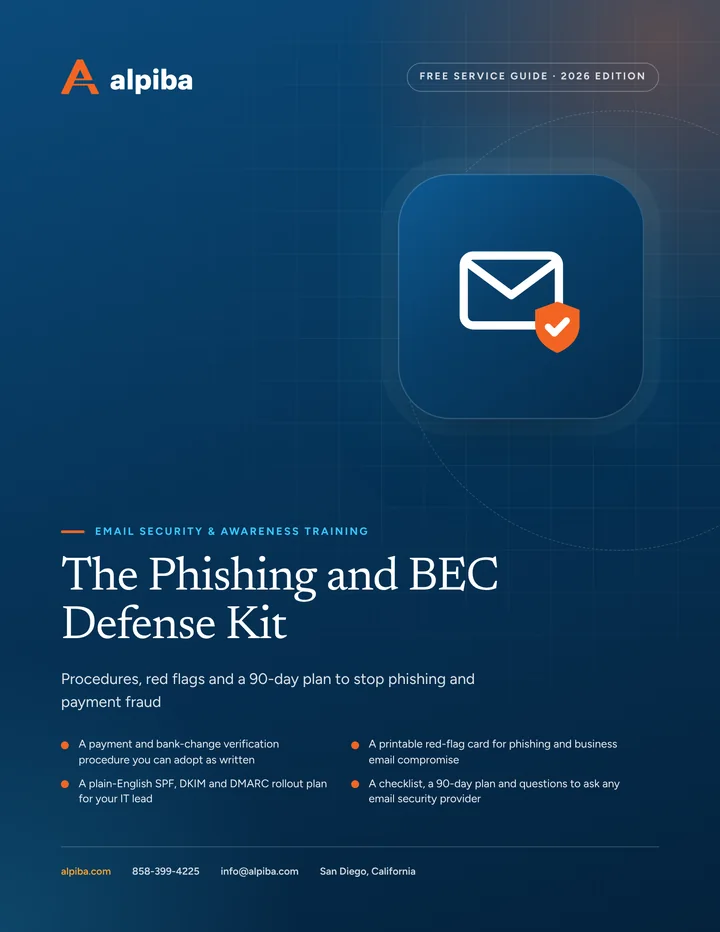
Cover of The Phishing and BEC Defense Kit

Service guide · Email Security & Training

The Phishing and BEC Defense Kit

A practical kit for owners, office managers and finance teams: a payment verification procedure, a printable red-flag card, a DMARC rollout plan and a reporting playbook.

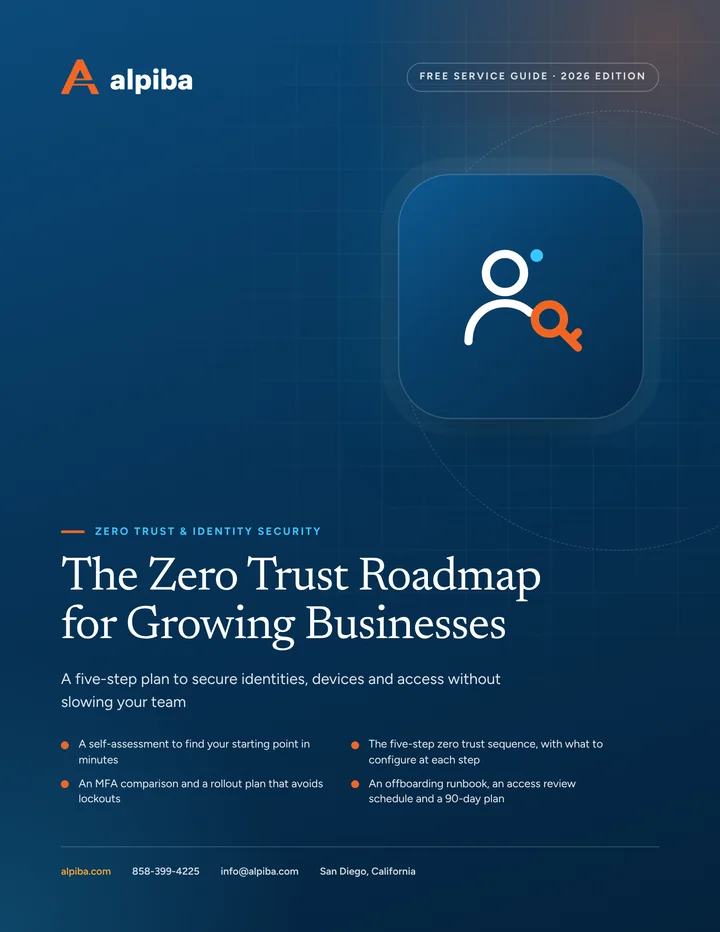
Cover of The Zero Trust Roadmap for Growing Businesses

Service guide · Zero Trust & Identity

The Zero Trust Roadmap for Growing Businesses

A staged, practical plan for owners and IT leads: where to start, which MFA to choose, how to handle admin accounts and how to keep access clean as people come and go.

Call Free assessment