SOC online 24/7Breach or outage? Call 858-399-4225

Free guidesinfo@alpiba.comMon–Fri, 7am–7pm PT

Alpiba

Free industry guide · PDF

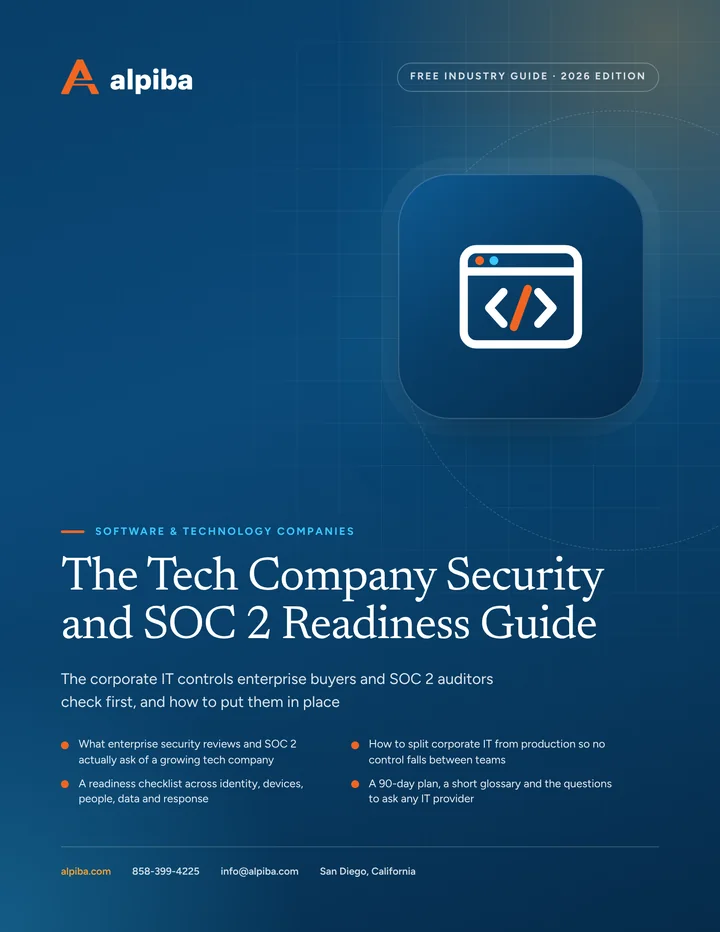
The Tech Company Security and SOC 2 Readiness Guide

The corporate IT controls enterprise buyers and SOC 2 auditors check first, and how to put them in place

  • What enterprise security reviews and SOC 2 actually ask of a growing tech company
  • How to split corporate IT from production so no control falls between teams
  • A readiness checklist across identity, devices, people, data and response
  • A 90-day plan, a short glossary and the questions to ask any IT provider

12 pages25-item checklist30/60/90-day plan

Cover of The Tech Company Security and SOC 2 Readiness Guide

Get your free copy

Instant PDF download. No sales pitch inside.

Instant download. By submitting, you agree that Alpiba may contact you about this guide; you can ask us to delete your details at any time.

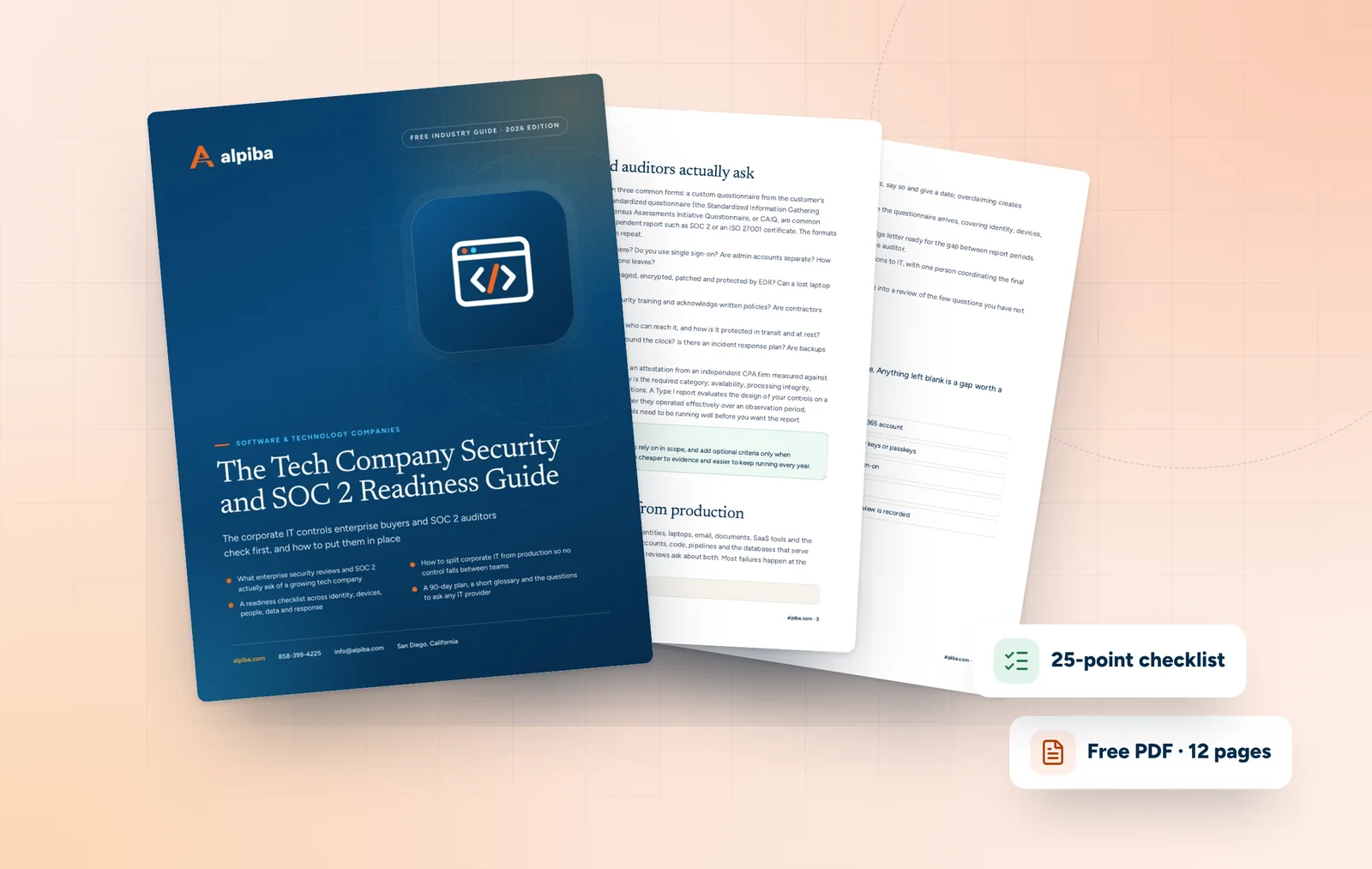
Cover and two sample pages of The Tech Company Security and SOC 2 Readiness Guide, a free 12-page PDF guide from Alpiba with a 25-point checklist
A look inside: the cover and two pages from the 12-page PDF.

What's inside

Inside the guide.

Most tech companies meet security compliance through a sales cycle. An enterprise prospect sends a questionnaire or asks for a SOC 2 report, and suddenly the company has to prove things it has never written down: who has access to what, whether laptops are encrypted, how fast leavers lose access and what happens when something goes wrong.

This guide covers the corporate IT side of that work, the part that sits outside your product and production cloud but inside almost every security review. Read it once, then work through the checklist with your operations and engineering leads together, and follow the 90-day plan in order. It does not replace your auditor or legal counsel; it helps you arrive prepared.

  1. What buyers and auditors actually ask
  2. Separate corporate IT from production
  3. The corporate IT baseline and its evidence
  4. The SOC 2 readiness path
  5. Answering security questionnaires well
  6. The checklist25 items in 5 groups
  7. Questions to ask any IT provider10 questions
  8. Your 30/60/90-day plan3 phases, step by step
  9. Plain-English glossary8 terms

Read Part 1 free

The opening chapter of the guide, in full. The rest of the guide, the checklist and the 90-day plan are in the PDF.

What buyers and auditors actually ask

Enterprise security reviews come in three common forms: a custom questionnaire from the customer's procurement or security team, a standardized questionnaire (the Standardized Information Gathering questionnaire, or SIG, and the Consensus Assessments Initiative Questionnaire, or CAIQ, are common examples), and a request for an independent report such as SOC 2 or an ISO 27001 certificate. The formats differ, but the questions behind them repeat.

  • Identity: Is MFA enforced everywhere? Do you use single sign-on? Are admin accounts separate? How fast is access removed when someone leaves?
  • Devices: Are laptops company-managed, encrypted, patched and protected by EDR? Can a lost laptop be locked or wiped?
  • People: Do employees complete security training and acknowledge written policies? Are contractors held to the same rules?
  • Data: Where does customer data live, who can reach it, and how is it protected in transit and at rest?
  • Response: Who watches for threats around the clock? Is there an incident response plan? Are backups tested?

Behind many of these requests sits SOC 2, an attestation from an independent CPA firm measured against the AICPA's Trust Services Criteria. Security is the required category; availability, processing integrity, confidentiality and privacy are optional additions. A Type I report evaluates the design of your controls on a single date. A Type II report also tests whether they operated effectively over an observation period, commonly three to twelve months, so controls need to be running well before you want the report.

Scope to what customers buy

Put the product and systems customers rely on in scope, and add optional criteria only when customers ask for them. A tight scope is cheaper to evidence and easier to keep running every year.

Get the full guide

A preview

A sample from the guide.

Here's the first checklist group and a few of the questions. The full guide has all 25 checklist items, 10 questions and the 90-day plan.

Identity and access

  • MFA is enforced on every Google Workspace or Microsoft 365 account
  • Admins use separate admin accounts protected by security keys or passkeys
  • Every app holding company or customer data uses single sign-on
  • Automated provisioning is on for every app that supports it
  • Access to critical systems is reviewed each quarter and the review is recorded

Questions to ask any IT provider

  1. 1Which corporate IT controls will you own, which stay with our engineering team, and will you put that split in writing?
  2. 2How do you buy, enroll and ship laptops to hires outside California, and how do you get them back when people leave?
  3. 3What happens, step by step, when an employee or contractor leaves, and how quickly is access removed everywhere?
  4. 4Who watches security alerts at 2am, people or software, and what is your average first response time?

+ 6 more questions in the full guide

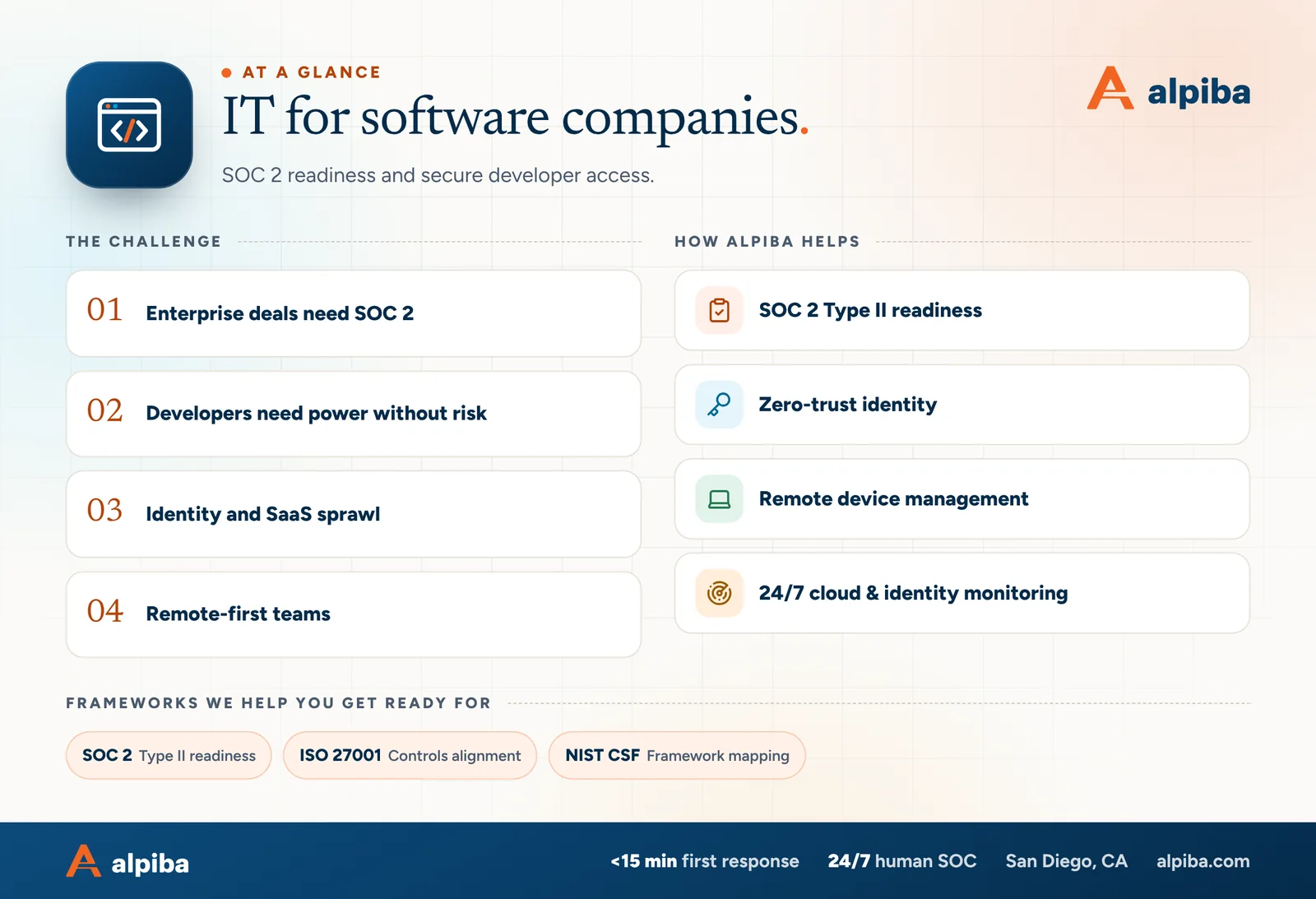
IT for software companies at a glance. Challenges: enterprise deals need soc 2, developers need power without risk, identity and saas sprawl and remote-first teams. How Alpiba helps: soc 2 type ii readiness, zero-trust identity, remote device management and 24/7 cloud & identity monitoring. Frameworks: SOC 2, ISO 27001 and NIST CSF.
IT for software companies at a glance.

Your first 30 days

Where to start this month.

The guide's 30/60/90-day plan begins with these steps. Assign an owner to each and review progress every two weeks.

  • 1Inventory people, accounts, laptops and SaaS apps, contractors included
  • 2Enforce MFA everywhere and create separate admin accounts
  • 3Remove stale accounts and agree the corporate IT and engineering split
  • 4List the deals asking for SOC 2 and set a target report date

Key terms in plain English

SOC 2 Type I
An independent auditor's report on whether your controls are suitably designed at a single point in time.
SOC 2 Type II
An auditor's report that also tests whether those controls operated effectively over an observation period.
Observation period
The span of time, agreed with your auditor, over which a Type II report tests your controls.
Trust Services Criteria
The AICPA criteria behind every SOC 2 report: security, plus optional availability, processing integrity, confidentiality and privacy.
Single sign-on (SSO)
Signing in once with a company identity to reach many apps, so access is granted and removed in one place.
SCIM
A standard that lets your identity provider create, update and remove accounts in other apps automatically.
MDM (mobile device management)
Software that enrolls company devices and enforces settings such as encryption, updates and remote lock.
Bridge letter
A statement from your management covering the time between the end of your last SOC 2 report period and today.
Roopa, founder of Alpiba

SMBs deserve a strategic technology partner, without enterprise complexity or cost.RoopaFounder, Alpiba

Put the guide to work

Services that help you act on it.

All services
A team in a working session around a conference table

Compliance & Risk

Compliance Readiness

Design, implement and evidence the controls auditors and insurers ask for, and keep the audit trail ready.

A padlock resting on a laptop keyboard

Cybersecurity

Zero Trust & Identity Security

Identity-aware access, MFA everywhere and least privilege baked into every environment we manage.

Laptops and notebooks spread across a team work table

Cloud & Productivity

Google Workspace Services

Expert migration, training and integration for secure collaboration across hybrid teams.

Keep reading

More free guides.

All guides
Cover of The Biotech and Life Sciences IT Security Guide

Industry guide · Biotech

The Biotech and Life Sciences IT Security Guide

A printable guide for founders, lab managers and operations leads: secure instruments that can't be patched, protect IP as the team grows and answer partner questionnaires with evidence.

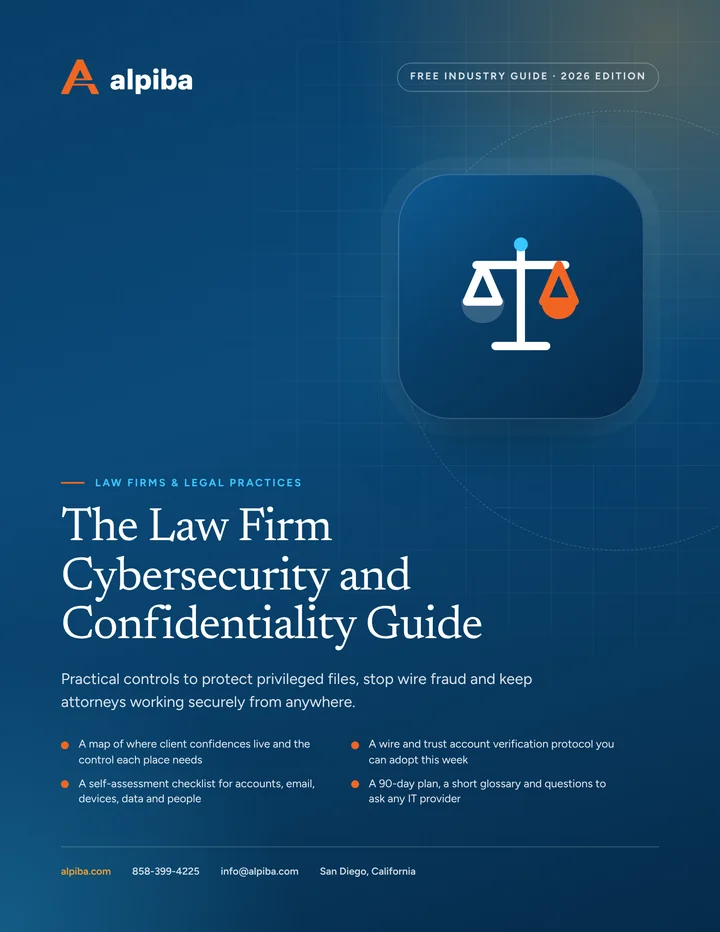
Cover of The Law Firm Cybersecurity and Confidentiality Guide

Industry guide · Legal

The Law Firm Cybersecurity and Confidentiality Guide

A printable guide for managing partners and firm administrators: where client confidences leak, how to stop payment fraud, how to secure court days and remote work, and how to stay ready for holds and client audits.

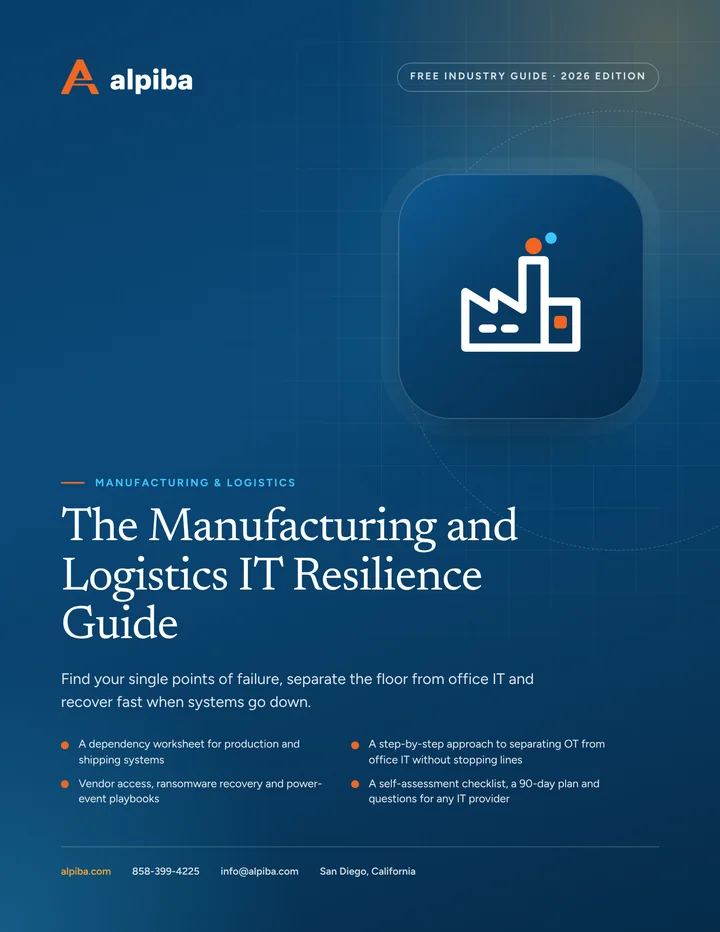
Cover of The Manufacturing and Logistics IT Resilience Guide

Industry guide · Manufacturing & Logistics

The Manufacturing and Logistics IT Resilience Guide

A printable guide for owners and operations leaders at plants, warehouses and distribution centers: what really stops production, how to segment equipment safely, how to control vendor access and how to plan for ransomware and power events.

Call Free assessment